
Peak Oil is You

Donate Bitcoins ;-) or Paypal :-)


Page added on January 9, 2013

About That Overpopulation Problem
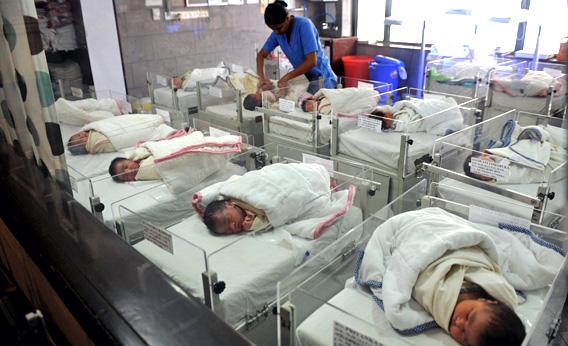
Research suggests we may actually face a declining world population in the coming years.
The world’s seemingly relentless march toward overpopulation achieved a notable milestone in 2012: Somewhere on the planet, according to U.S. Census Bureau estimates, the 7 billionth living person came into existence.
Lucky No. 7,000,000,000 probably celebrated his or her birthday sometime in March and added to a population that’s already stressing the planet’s limited supplies of food, energy, and clean water. Should this trend continue, as the Los Angeles Times noted in a five-part series marking the occasion, by midcentury, “living conditions are likely to be bleak for much of humanity.”
A somewhat more arcane milestone, meanwhile, generated no media coverage at all: It took humankind 13 years to add its 7 billionth. That’s longer than the 12 years it took to add the 6 billionth—the first time in human history that interval had grown. (The 2 billionth, 3 billionth, 4 billionth, and 5 billionth took 123, 33, 14, and 13 years, respectively.) In other words, the rate of global population growth has slowed. And it’s expected to keep slowing. Indeed, according to experts’ best estimates, the total population of Earth will stop growing within the lifespan of people alive today.
And then it will fall.
This is a counterintuitive notion in the United States, where we’ve heard often and loudly that world population growth is a perilous and perhaps unavoidable threat to our future as a species. But population decline is a very familiar concept in the rest of the developed world, where fertility has long since fallen far below the 2.1 live births per woman required to maintain population equilibrium. In Germany, the birthrate has sunk to just 1.36, worse even than its low-fertility neighbors Spain (1.48) and Italy (1.4). The way things are going, Western Europe as a whole will most likely shrink from 460 million to just 350 million by the end of the century. That’s not so bad compared with Russia and China, each of whose populations could fall by half. As you may not be surprised to learn, the Germans have coined a polysyllabic word for this quandary: Schrumpf-Gessellschaft, or “shrinking society.”
American media have largely ignored the issue of population decline for the simple reason that it hasn’t happened here yet. Unlike Europe, the United States has long been the beneficiary of robust immigration. This has helped us not only by directly bolstering the number of people calling the United States home but also by propping up the birthrate, since immigrant women tend to produce far more children than the native-born do.
But both those advantages look to diminish in years to come. A report issued last month by the Pew Research Center found that immigrant births fell from 102 per 1,000 women in 2007 to 87.8 per 1,000 in 2012. That helped bring the overall U.S. birthrate to a mere 64 per 1,000 women—not enough to sustain our current population.
Moreover, the poor, highly fertile countries that once churned out immigrants by the boatload are now experiencing birthrate declines of their own. From 1960 to 2009, Mexico’s fertility rate tumbled from 7.3 live births per woman to 2.4, India’s dropped from six to 2.5, and Brazil’s fell from 6.15 to 1.9. Even in sub-Saharan Africa, where the average birthrate remains a relatively blistering 4.66, fertility is projected to fall below replacement level by the 2070s. This change in developing countries will affect not only the U.S. population, of course, but eventually the world’s.
Why is this happening? Scientists who study population dynamics point to a phenomenon called “demographic transition.”
“For hundreds of thousands of years,” explains Warren Sanderson, a professor of economics at Stony Brook University, “in order for humanity to survive things like epidemics and wars and famine, birthrates had to be very high.” Eventually, thanks to technology, death rates started to fall in Europe and in North America, and the population size soared. In time, though, birthrates fell as well, and the population leveled out. The same pattern has repeated in countries around the world. Demographic transition, Sanderson says, “is a shift between two very different long-run states: from high death rates and high birthrates to low death rates and low birthrates.” Not only is the pattern well-documented, it’s well under way: Already, more than half the world’s population is reproducing at below the replacement rate.
If the Germany of today is the rest of the world tomorrow, then the future is going to look a lot different than we thought. Instead of skyrocketing toward uncountable Malthusian multitudes, researchers at Austria’s International Institute for Applied Systems Analysis foresee the global population maxing out at 9 billion some time around 2070. On the bright side, the long-dreaded resource shortage may turn out not to be a problem at all. On the not-so-bright side, the demographic shift toward more retirees and fewer workers could throw the rest of the world into the kind of interminable economic stagnation that Japan is experiencing right now.
And in the long term—on the order of centuries—we could be looking at the literal extinction of humanity.
That might sound like an outrageous claim, but it comes down to simple math. According to a 2008 IIASA report, if the world stabilizes at a total fertility rate of 1.5—where Europe is today—then by 2200 the global population will fall to half of what it is today. By 2300, it’ll barely scratch 1 billion. (The authors of the report tell me that in the years since the initial publication, some details have changed—Europe’s population is falling faster than was previously anticipated, while Africa’s birthrate is declining more slowly—but the overall outlook is the same.) Extend the trend line, and within a few dozen generations you’re talking about a global population small enough to fit in a nursing home.
It’s far from certain that any of this will come to pass. IIASA’s numbers are based on probabilistic projections, meaning that demographers try to identify the key factors affecting population growth and then try to assess the likelihood that each will occur. The several layers of guesswork magnify potential errors. “We simply don’t know for sure what will be the population size at a certain time in the future,” demographer Wolfgang Lutz told IIASA conference-goers earlier this year. “There are huge uncertainties involved.” Still, it’s worth discussing, because focusing too single-mindedly on the problem of overpopulation could have disastrous consequences—see China’s one-child policy.
One of the most contentious issues is the question of whether birthrates in developed countries will remain low. The United Nation’s most recent forecast, released in 2010, assumes that low-fertility countries will eventually revert to a birthrate of around 2.0. In that scenario, the world population tops out at about 10 billion and stays there. But there’s no reason to believe that that birthrates will behave in that way—no one has every observed an inherent human tendency to have a nice, arithmetically stable 2.1 children per couple. On the contrary, people either tend to have an enormous number of kids (as they did throughout most of human history and still do in the most impoverished, war-torn parts of Africa) or far too few. We know how to dampen excessive population growth—just educate girls. The other problem has proved much more intractable: No one’s figured out how to boost fertility in countries where it has imploded. Singapore has been encouraging parenthood for nearly 30 years, with cash incentives of up to $18,000 per child. Its birthrate? A gasping-for-air 1.2. When Sweden started offering parents generous support, the birthrate soared but then fell back again, and after years of fluctuating, it now stands at 1.9—very high for Europe but still below replacement level.
The reason for the implacability of demographic transition can be expressed in one word: education. One of the first things that countries do when they start to develop is educate their young people, including girls. That dramatically improves the size and quality of the workforce. But it also introduces an opportunity cost for having babies. “Women with more schooling tend to have fewer children,” says William Butz, a senior research scholar at IIASA.
In developed countries, childrearing has become a lifestyle option tailored to each couple’s preferences. Maximizing fertility is rarely a priority. My wife and I are a case in point. I’m 46, she’s 39, and we have two toddlers. We waited about as long to have kids as we feasibly could because we were invested in building our careers and, frankly, enjoying all the experiences that those careers let us have. If wanted to pop out another ankle-biter right now, our ageing bodies might just allow us to do so. But we have no intention of trying. As much as we adore our little guys, they’re a lot of work and frighteningly expensive. Most of our friends have just one or two kids, too, and like us they regard the prospect of having three or four kids the way most people look at ultramarathoning or transoceanic sailing—admirable pursuits, but only for the very committed.
That attitude could do for Homo sapiens what that giant asteroid did for the dinosaurs. If humanity is going to sustain itself, then the number of couples deciding to have three or four kids will consistently have to exceed the number opting to raise one or zero. The 2.0 that my wife and I have settled for is a decent effort, but we’re not quite pulling our weight. Are we being selfish? Or merely rational? Our decision is one that I’m sure future generations will judge us on. Assuming there are any.
22 Comments on "About That Overpopulation Problem"
rollin on Wed, 9th Jan 2013 11:15 pm
If just education and techno-selfishness is causing a population reduction, then what is going to happen as resources deplete, food systems fail and climate kicks everything into a new paradigm?
ken nohe on Thu, 10th Jan 2013 1:08 am
Of course the population growth is declining, this is a known and well studied phenomenon. It is just not happening fast enough! Population keeps growing all over the place thanks to available resources until we hit a wall. When the wall is reached, resources are still there but the marginal cost explodes because the extra resources needed are no longer available and the population crashes. We are already well beyond “sustainable” and there is therefore no chance left to avoid this fate. This is a pessimistic assessment which would take far more than a marginal decline in “growth rate” to invalidate. Population doubling in 13 years instead of 12? Come on!
GregT on Thu, 10th Jan 2013 1:45 am
Many scientists believe that the planet earth was capable of sustaining a human population of around 1 billion people. That was before we decimated the rivers, the forests, the climate, and the oceans. The earth’s ecosystems are in a rapid state of decline, and they are not going to recover any time soon.
The only reason that our population has grown so rapidly is because we found a cheap abundant energy source called oil.
Using the IEA’s latest report on the world’s remaining oil reserves (which are hugely overstated) we have around 37 years of oil left. When it is gone, we will be lucky if the earth can sustain 500 million people.
If the Arctic methane feedback loop kicks in, we could be wiped out completely in a few decades.
BillT on Thu, 10th Jan 2013 2:29 am
“..within the lifetimes of people today…” Hahahahahaha…
How about in the next decade? They basically wasted their time with this propaganda piece. They said nothing new using thousands of words.
Mother Nature is going to reduce population in a most radical way, starvation. And it is going to accelerate exponentially every year until we are numbered in the low millions, not billions. If the temperatures do increase 6-7C. There may not be any of us around to count.
DC on Thu, 10th Jan 2013 3:52 am
This article takes a well worn falsehood and runs with it. The old, “But but the worlds birth rate is declining!”. Well, no. The *rate* of increase may be declining somewhat, not the overall birth rate. I say ‘may be’ because that statistic like many others these days, could well be falsified as well. Anyhow, a decline in the rate of growth is NOT a decline in the over birth rate. With a few exceptions, almost every nation on Earth is still increasing its population. Thats nearly every…single…country on earth will have more people not less. The idea that might have them a slightly slower rate is immaterial.
I dont know why people fall for the decline in the *rate* of increase as if it means its a aggregate decrease. It is nothing of the sort. But it *sounds* like its good news, so people swallow it wholesale. It probably explains why people in say, the US, think there going to ‘energy independent’ (LOL!), while continuing to import massive amounts of fossil-fuel from Mexico, Canada, and elsewhere. Seems to me to be the same mental gymnastics at work with both ideas. Why does no ever seem to ask anyone promoting that dubious notion to explain how a world with ten billion, up from seven is a decrease of anything? When I went to school, I was taught 10 is a more than 7.
Kenz300 on Thu, 10th Jan 2013 6:05 am
Every country needs to balance its population with its resources, food, water, energy and jobs.
Europe and the US both have very high unemployment rates and even higher under employment rates.
If you can not provide for yourself you can not provide for a child. In the worlds poorest countries people have yet to figure that out. This just locks the family into a cycle of poverty, hunger and despair.
Access to family planning services needs to be available to all that want it.
ken nohe on Thu, 10th Jan 2013 7:22 am
Weather variations may well do us in, it has happened many time in the past and is bound to happened again but forget about rising oceans, temperatures exploding and the rest. This is mostly propaganda with very little ground to stand on. Yes the melting of the arctic ocean is of concern but that’s about it. All the rest is SF and within natural boundaries.
I know most people will never believe that, especially those who have never seen to what extremes nature is capable. But there is one hope: The activity of the sun is slowing down markedly right now to such an extent that we may be on the verge of entering a new “minimum”. If that is the case, we may encounter very cold years ahead indeed. So much for anthropomorphic warming. This doesn’t mean that we shouldn’t curb CO2 production, just that it is a concern among others. Destroying the forest the way we do it is to my opinion a more pressing issue closely related to overpopulation and overconsumption.
BillT on Thu, 10th Jan 2013 8:34 am
And the 129 degree F. temperatures in Australia are ‘normal’ ken?
The fact that the Arctic was almost ice free this summer is ‘normal’?
A hurricane hitting NYC in October is ‘normal’?
The measured rising of sea level is ‘normal’?
The ability of a palm tree to live through the winter in Pennsylvania is ‘normal’?
Or is it just a heavy case of denial?
BillT on Thu, 10th Jan 2013 11:34 am
Ken, “… a new Maunder Minimum would lead to a cooling of 0.3°C in the year 2100 at most – relative to an expected anthropogenic warming of around 4°C…”
Looks like the jury is out on any real cooling this time around. Sorry. The last cooling was also accompanied by lower CO2 levels and increased volcanic eruptions, both known to lower temperatures. Search: “What if the Sun went into a new Grand Minimum?”
Filed under: Climate Science – Sun-earth connections — group 19 June 2011. I would say that destroying the oceans are far worse than the trees. (acidification) but it doesn’t matter. We have passed the point of no return. Best we can do is try to keep the maximum temperatures as low as possible by collapsing the world economy to the point that hydrocarbon use is drastically cut.
Tom Molin on Thu, 10th Jan 2013 11:58 am
In percent growth we peaked in 1962 and 1963 at 2.20% per annum.
Today ~1,0x%
The actual annual growth in the number of humans peaked at 88.0 million in 1989.
Today about 40 million
Tom Molin on Thu, 10th Jan 2013 12:08 pm
The actual annual growth in the number of humans is of course around 70 million with 1% growth!
econ101 on Thu, 10th Jan 2013 2:36 pm
All nonesensical thinking aside, the world is not ending in ten years. The climate is not spinning out of control, the population is flucuating and nature will not let it exceed the ability of the world to support it. It will all be good and it will depress a lot of people that want or think the end is near.
ken nohe on Thu, 10th Jan 2013 2:58 pm
129C in Australia? No problem whatsoever! The outback is made to burn with most, all? plants needing heat to reproduce. Australia in the recent past has known 1,000+ year periods of extreme dryness. 90% of the country is a desert, one of the harshest on the planet. But areas which haven’t seen a drop of water for decades can become green within a couple of weeks. I saw it last year. It is just unbelievable.
Arctic ice free is not “normal” but it could well be the continuation of the “natural” warming period we are in. We will see if it gets worse or stops in the coming years. This is really the “only” solid evidence for now supporting the case for global warming.
Hurricane hitting NYC in October is absolutely normal, Yes, sorry. In fact, few scientists that I know put this on global warming. It just happens once every century or so but is well within the bounds of “normal” climates anomalies. Worse, global warming would probable reduce the number of hurricanes, not increase it. But never mind. If you look at recent statistics, there is neither an increase nor a decrease in this respect. All within natural fluctuations… for the time being. (And yes, they are large.)
As for Palm Trees in Pennsylvania; of course it is normal. Plants spend their time growing where they should not. And they you have a great cold and they are gone.
Anyway; my point is not to deny anything. I am open minded about global warming. I did see a clear trend in the 1990s in many countries. I just don’t see it anymore in the 1990s. Yes the climate is changing but we were incredibly lucky in the 20 century to have a very stable weather for so long. It is quite likely that it is over and that the fluctuation may become wilder from now on, as they were earlier.
I personally expect some meaningful cooling over the coming few years. We’ll see. We already got -10C in Tokyo in mid December last month which was the first time ever… And the recent winter was extremely cold both in Australia and New Zealand… To be continued.
BillT on Thu, 10th Jan 2013 3:22 pm
Lol..ok, ken, so you will wait and see what happens. Me too, but I am not as laid back as you. I remember my childhood in Pennsylvania. The climate there has definitely warmed over the last 60 years. Yes there are extremes, and exceptions, but, over all, it is warmer. Now I live in the Philippines and look forward to seeing decades of change here also.
Rick on Thu, 10th Jan 2013 5:04 pm
I’m surprised that Ken is a AGW denier. Good luck with that Ken.
PS – It’s going to be 55° F in the Chicagoland tomorrow, and it’s January.
BTW, AGW is not just about a warming planet, but a planet of unstable weather. Weather so bad, it will not allow for farming, etc. And the sun is not the cause of climate change.
GregT on Thu, 10th Jan 2013 10:52 pm
Ken Nohe,
“Destroying the forest the way we do it is to my opinion a more pressing issue closely related to overpopulation and overconsumption.”
The forests where I live in British Columbia, are being decimated. They are not being decimated from overpopulation or overconsumption. They are dying as a result of an increase in mean temperature. The Mountain Pine Beetle has historically been kept in check by cold winter temperatures. Not any more. 20 million hectares ( Half the size of Japan) of forest have been wiped out in the past 7 years and the beetle is continuing to wipe out a further 5 million hectares per year. Central BC is covered in standing dead trees, the potential for a massive firestorm is severe and unprecedented.
The world’s scientific community changed the name from “Global Warming” to “Climate Change” for a very good reason. They understood that Global Warming would also effect colder than normal temperatures in some places. They felt that some people would misinterpret these colder temperatures as a sign that Global Warming was not real. Exactly what you are doing.
You can ‘personally expect” what you like, but please do some research on Climate Change. It would probably be a good idea to listen to what the world’s leading scientists are SHOUTING to us about. Climate Change is real, it is anthropogenic, and if we do something about it now, our species still has a chance of survival. It is too late, however to expect the future to look anything like what we have become accustomed to. It may also be too late to stop our own extinction, if certain positive feedback loops kick in.
Do a bit of research on the Jetstream and you will understand what is causing the record breaking weather in the Northern Hemisphere. The Colder temperatures that Japan is experiencing are exactly what is expected from Global Warming/ Climate Change.
kiwichick on Fri, 11th Jan 2013 12:03 am
ken; suggest you read “6 Degrees ”
by mark lynas
get back to us when you’ve read it
as for the article above…. well we all need a chuckle now and again
ken nohe on Fri, 11th Jan 2013 12:24 am
Lucky you, I’d love to be in the Philippines. I am fascinated by the Chocolates hills as well as a few other geologic oddities of the country without mentioning some of the most superb volcanoes around. Yes I am aware that the Borealis forests are dying, I’ve seen it in Canada but it is also true in Russia. In fact it is more complex as they are also creeping up on the tundras. I was interested by these forests when I was in Finland and found out that they are actually very “poor” ecosystems which appear almost overnight after a glaciation and disappear just as fast. They actually go up and down and up again at an incredible speed… Unlike tropical forests. Which have been where they are for millions of years and need those eons to develop their unbelievable diversity. They do disappear also from time to time but then need a huge amount of time to reestablish themselves unlike their northern siblings. To destroy the tropical forests the way we do it is a tragedy, the same thing in the North; not so much.
As for the cold weather and “climate change” yes, very true, they are indeed compatible. The problem is not the trends that we “see” or do not see, it is the linkage. The scientists are very careful in their messages (some less than others) and often say: “We’re not sure or we don’t know.” But all the nuance are gone in the public discourse. My questioning is not with Global Warming as such, there are some obvious trends, but with an absolute massage: “If we do not stop global warming, we’ll die!” which is alarmist and nonsensical.
The problem is NOT global warming as such: what we see for now is small statistically and not the end of the world and if it’s true it is in any case unstoppable. The problem is that we are attacking the consequences, not the causes. And we do that because socially, our politicians know that they can do nothing about the causes* Population explosion thanks to cheap energy and an economic model based on greed. If you agree with that then you will realize that all the “talk” currently is just that. You can trade all the carbon you want, promote all the new energies, which for now consume more resources than they produce and achieve exactly nothing. Oh yes sure, you transfer large sums of money to farmers in the Midwest and to the elites of developing countries to keep them “quiet”, aims which suspiciously aligned to what our governments would like to do anyway. It would be great if those things also had “nice” consequences, but if not, well, tough luck.
This is why I find the message: “We still have time but if we don’t do something immediately it will be too late!” so irritating. This message has nothing to do with “saving the planet” and everything to do with saving the interest of the people who push it. It is manipulation on a grand scale. The planet does not need to be “saved”. It is an “ecosystem” on which we depend 100%. If we unbalance it, which we are doing, well, it will just find a new equilibrium and we will have to cope with that. It won’t be the end of the world, not even the end of mankind. Probably the end of our society but then again who will mourn it?
ken nohe on Fri, 11th Jan 2013 12:35 am
Sorry for the long note but I hope it was clear enough to show you that you’re barking at the wrong guy. I am not “your” ideal climate change denier from the “4000 year-old flat earth society”. Often when I hear about something, I go and have a look. And what I find is often worse or far less but almost always different than what you read in the papers (or on the net). As the “Architect” in the Matrix said: Everything has a purpose. Find the purpose and you will understand why it is there. It works for Global Warming!
christian phillip on Fri, 11th Jan 2013 1:18 am
i salute all smarties that exist on this site…i was pleasantly surprised to notice them…now yoyo’s get ready for cannibalism and stop whinning about your lack of future on line…you still have your video games yet, or whatever you call that junk…be creative and eat yourself in your games…the writer was right only in the end…”future generations. if they exist…”…hahahahhaahaahahahaaaaaaaa, good one though…ciao
GregT on Fri, 11th Jan 2013 5:26 am
Ken,
You are only repeating what has been printed in the newspapers and is all over the Internet. The scientific community is desperately trying to get through to people, but very few are listening.
I urge you to please, go have a look.
ken nohe on Fri, 11th Jan 2013 11:14 am
Greg,
That is good then because it is not what I read. I don’t read the papers or watch TV (I don’t have one anymore) but conversely I do follow closely a lot of statistics. Sun activity is one, Ice cover is another one (more important than sea ice cover I believe and retreating faster) and yes some do show a clear trend towards warming. But is it man made? I don’t know. It doesn’t mean I think it is not. I just don’t know. As I explained earlier, I do not trust computer models. Here I am rather well positioned for my opinion: I build some. So I know what they are worth. Not “nothing” but not the certainty that people profess either.
I do believe that we are doing a lot of things which in the long term are harmful. Excessive release of CO2 is one, destroying the forests is another one, depleting the aquifers, arable land, sea acidification, and heavy metals, but then what? We are not going to change. Just today the Japanese government announced a 220 bn dollar package to revive the economy, not to save the earth. People are in the “business” of putting their hands on as much wealth as possible, not “being nice”. We can regret it but in real life, that’s what it is. And this said, in the end, often by accident, sometimes by design we do the right things, mostly after having tried all the wrong one. That is why I am not over pessimistic. Yes we are headed for “difficult” times, but we will probably find a way.
Let’s look at it another way. In medical terms a “pregnancy” is in fact a battle between a fetus which wants to acquire as much resources as possible and a mother’s body who wants to give as little as possible. Well, seen this way, the earth is “pregnant” of mankind. It is not going great but no need for an abortion yet!