
Peak Oil is You

Donate Bitcoins ;-) or Paypal :-)


Page added on December 9, 2012

Is Real Food Too Expensive?

Please don’t claim real food is “too expensive” to eat. What’s “too expensive” is unhealthy processed and fast foods.
It is a truism that food is expensive in America. What if we ask, “is real food expensive in America?”
Let’s define “real food” as unprocessed or minimally processed: raw fruits and vegetables, whole grains, unprocessed meat. Minimally processed would include rolled oats, 100% whole wheat bread, tofu, etc.
Exhibit #1: I recently bought this real food, here in America, for less than $5: 9 oranges, large bag of mustard cabbage, large bag of Shanghai bok choi and a large bag of malabar spinach. It was not in the “half off” bin; I paid the full retail price:
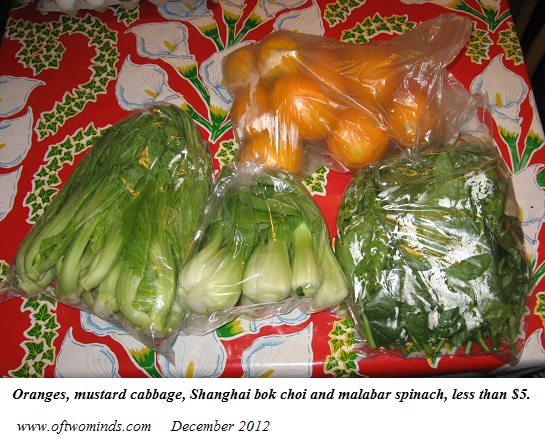
Exhibit #2: all of the above, plus 30 eggs and a hand of bananas: total less than $10:
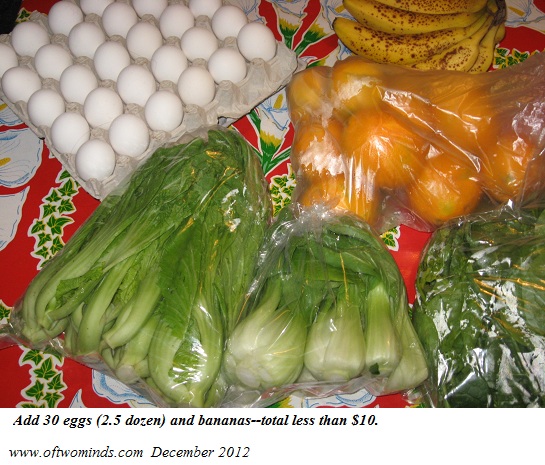
Each of these vegetables makes 4 to 6 servings, and the 2.5 dozen eggs provides plenty of protein for multiple meals. I could have added some excellent frozen fish for under $2 a pound, and cooked a few ounces per serving–a typical serving in traditional Asian cuisine, where one piece of chicken is thinly sliced and added to vegetables to feed four people.
$10 in fast food might get you two “value meals” of saturated-fat burgers, fries and sugar-water drink. $10 in packaged food will buy an assortment of fake-food: frozen pizzas, snacks, sugar-bomb breakfast bars, etc.
Is real food expensive in America? As a percentage of median household income ($49,777), no. Is processed or fast food expensive? If the “value” is measured in nutrition and well-being, yes, the cost is very high indeed.
Apologists often cite four reasons why people (and more particularly, low-income people) tend to eat so poorly in America. One is the high cost of “real food.” This is not quite true, as shown above: if you shop at Asian or Latin markets, you will find prices for fresh produce and other real food is typically much lower than in conventional supermarkets.
The second reason offered is that there are no grocery stores in low-income areas. This is also not quite true, as the aforementioned ethnic markets are typically only found in low-income immigrant-friendly areas.
The third excuse is that low-income people lack a proper stove/oven. The majority of Indian, Chinese and southeast Asian cuisine is prepared in one saucepan or wok that only needs one burner, a cutting board, one knife and a stirring/serving tool. The variety and healthy qualities of these cuisines are well-known. You only need one burner and a single saucepan/wok to make a huge range of healthy meals.
The fourth reason given is that people work long hours and have no time to cook, especially low-income workers with long commutes on public transport.
I routinely prepare a healthy meal with the above vegetables or equivalent (green beans, etc.) and a few ounces of meat in about a half hour. With a pressure cooker (widely available at garage sales, etc.), you can prepare a pot of beans or lentils (dal) in less than an hour.
Compare these modest investments of time with surveys that routinely find Americans of all incomes and ethnicities watch up to four hours of TV or equivalent “entertainment” (web-surfing, videogaming, etc.) a day. Some surveys put the total even higher than four hours.
So the apologists are claiming that people find four hours to watch TV, etc., but they have to stop at fast food outlets for dinner because they have no time to prepare a meal with real food.
None of these excuses hold water. Even more absurdly, some apologists claim that “people don’t know how to cook.” With dozens of cooking shows being broadcast and thousands of recipes available to anyone with a smartphone or Internet connection, this strains credulity. There are even these useful things called cookbooks that can be borrowed from a public library.
Let’s also recall that up to 40% of all food in the U.S. is thrown in the garbage. Do you throw away what is costly? No, you throw away what is cheap.
What it boils down to is convenience, marketing and engineering: processed food and fast-food are engineered to “taste good” (i.e. salty, fatty and sweet), marketing hypes them 24/7 and Americans have been brainwashed to worship convenience above all else.
So please don’t claim real food is “too expensive” to eat. What’s “too expensive” is unhealthy processed and fast foods.
Charles Hugh-Smith of OfTwoMinds blog
3 Comments on "Is Real Food Too Expensive?"
BillT on Mon, 10th Dec 2012 1:20 am
Ok, so, if you buy these during the growing season locally, you might buy them for that price, and likely, the oranges and bananas were shipped in so they cost most of the amount, but, you will not eat so cheap in February in the northern states. And you will NOT get enough fiber or calories from those foods if you are active. There are no grains there at all. 2,000 calories per day for a working adult = everything in the first $5 picture +++. And it would take all of the fruits and veggies and 6 eggs to get that many calories from the $10 picture.
1 banana = ~100 c.
1 egg = ~80 c.
Most eggies are low in calories and 2 cups may = 100 c.
I agree that you can eat cheaper, but you probably cannot get the same number of calories from fresh as you get from ‘junk’ and we are trained to eat junk. You cannot get enough calories without meat and grains and those are expensive. Also, try buying these same items in off season. Or when transport costs get higher. We will be eating a lot less soon.
yeahbut on Mon, 10th Dec 2012 6:03 am
Yes billt, that is why part of eating ‘real’ food is eating what crops are available seasonally. Or that store well. Like we did for the previous 10,000 years. I just finished eating a meal of red beans, canned tomatoes, onions garlic and brown rice. It was delicious, nutritious and so ridiculously cheap it might as well have been free- but I had to do a tiny bit of forward planning, like soaking the beans the day before and putting the rice on to cook a while before I wanted to eat because ‘real’ rice takes a bit longer.
All apologists who argue that food is expensive in the developed world are in fact arguing that easy to access, minimal preparation processed foods are expensive, and that the alternative, unprocessed food, is difficult. Not expensive, difficult. So…easy and expensive, or cheap and difficult. I would have thought anyone who is genuinely poor would have no problem figuring out which option is best for them.
And finally, it seems to me that a deficiency of calories is the last thing we need to worry about in the developed world, particularly amongst the poor. Obesity is the epidemic of the poor in the first world. Excess, empty, processed calories are the issue, not a lack of calories.
Grover Lembeck on Mon, 10th Dec 2012 4:48 pm
Seeds are cheap, also. Mr. Hugh-Smith should have included a bag of rice, which would have boosted the calorie count considerably (though it would take an additional pot or a 10 dollar rice cooker). BillT is right about the calorie count- I do manual labor for a living, and this food would keep me going for about 2 cholesterol filled days.
A note on pressure cookers from garage sales- don’t do this. They can be very dangerous. If you do get one, have it tested by your state ag office extension.