
Peak Oil is You

Donate Bitcoins ;-) or Paypal :-)


Page added on December 4, 2012

Oil Watch – OECD oil production (IEA)

Executive summary
According to BP, OECD oil production (C+C+NGL) peaked at 21.67 million bpd in 1997. Monthly production data from the International Energy Agency (IEA) now suggests that production has been stable for 5 years at around 18.5 million bpd (Figure 1).
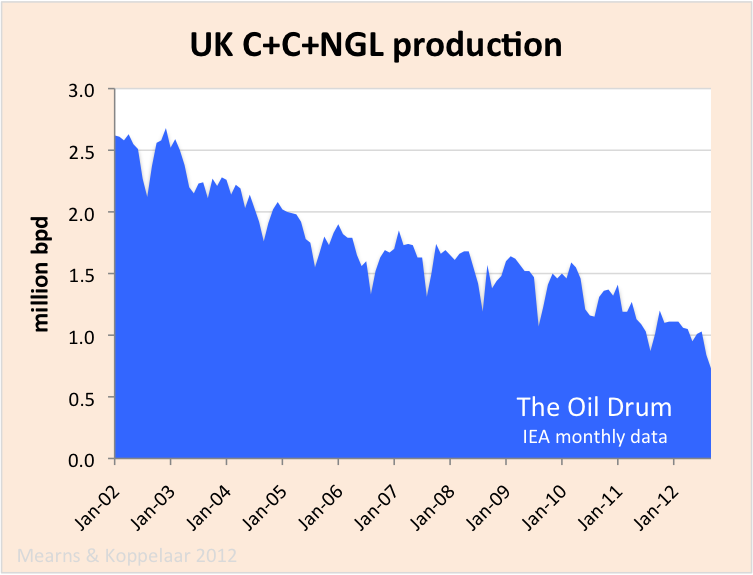
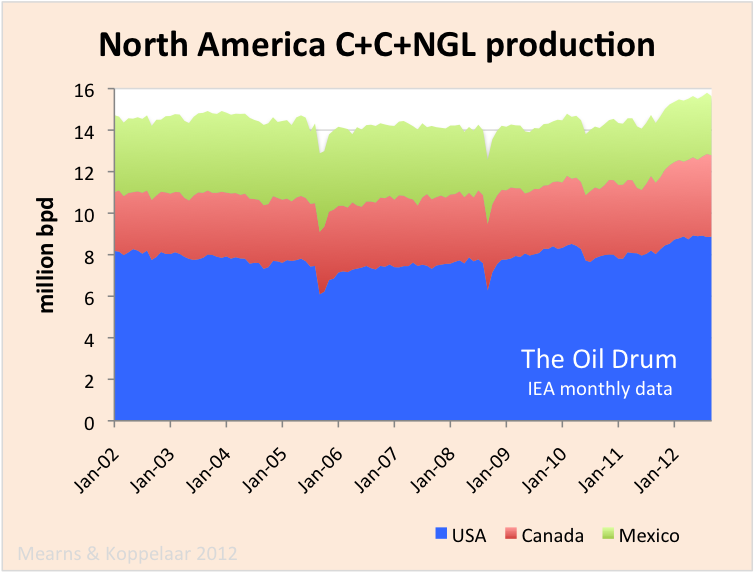
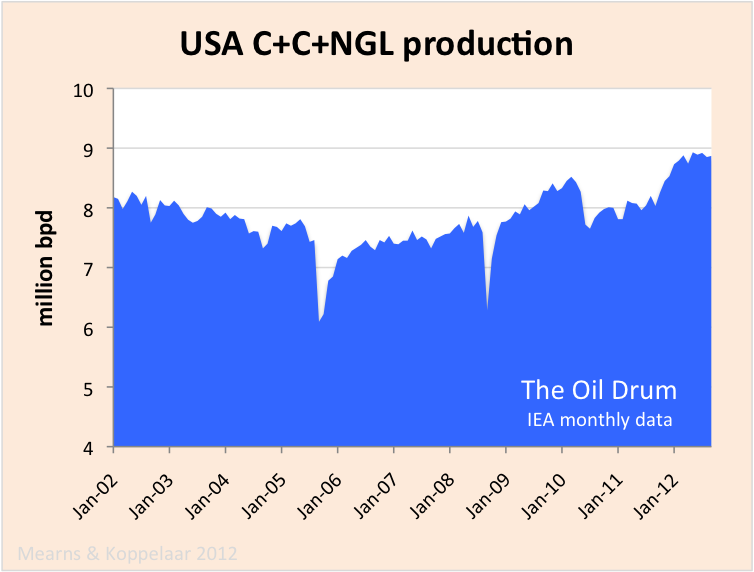
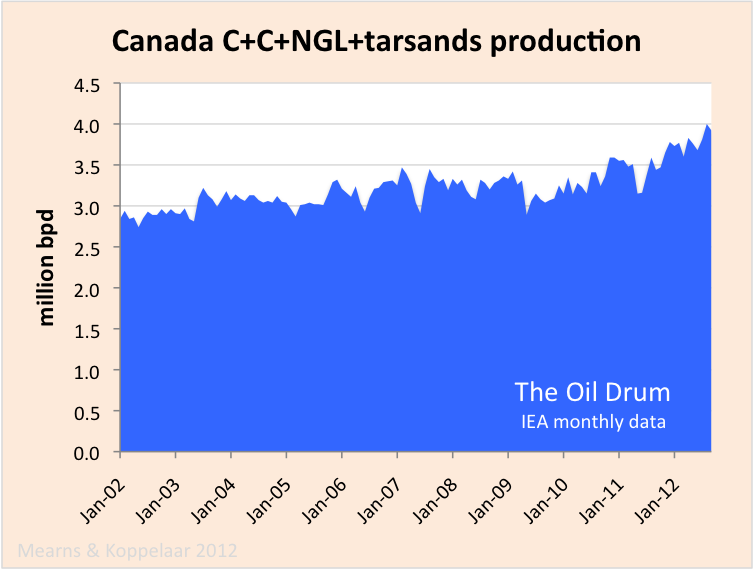
The North Sea (UK and Norway) is still in steep decline. This has been offset by growing production in the USA and Canada where non-conventional tight oil and tar sands production are offsetting declines in conventional crude in these countries.
Mexico, the other big OECD producer, has managed to arrest declines by switching nitrogen injection supply from Cantarell to Ku Maloob Zaap and has had stable production of just below 3 million bpd for three years.
From May 2007 to August 2010, Rembrandt Koppelaar published an e-report called Oil Watch Monthly that summarised global and national oil production and consumption data from the International Energy Agency (IEA) of the OECD and Energy Information Agency (EIA) of the USA. This is the third in a series of new Oil Watch reports, co-authored with Rembrandt and details crude oil production data for the OECD countries as reported by the International Energy Agency. Earlier editions:
Oil Watch – World Total Liquids Production
Oil Watch – OPEC Crude Oil Production (IEA)
Europe
European oil production is dominated by the North Sea and adjacent off shore areas. The big two producers are the UK and Norway with lesser oil production in Denmark, Germany and The Netherlands. Italy also has a small oil industry. The small producers are not documented separately by the IEA and are aggregated as “Other Europe”.
European production has annual cyclicity where production is reduced in the summer months to allow for maintenance of aging offshore infrastructure (Figure 2)

In April 2011, a cash strapped UK government raided North Sea production for an additional £10 billion in tax and this caused activity to freeze over for a while. But the main cause of the free fall has more to do with installations being shut down for repairs such as Buzzard, Schiehallion and Elgin. In the wake of Deep Water Horizon there is hightened awareness of safety and the cost of disaster.
Much of the steel constructed UK infrastructure was designed for 20 years service and has ben out there for 40 years. It seems likely that other offshore provinces such as The Gulf of Mexico, Brazil and Angola will eventually succumb to the same fate as the UK.

North America
North American oil production has been largely flat over the decade but is now clearly rising again (Figure 5).

Australia
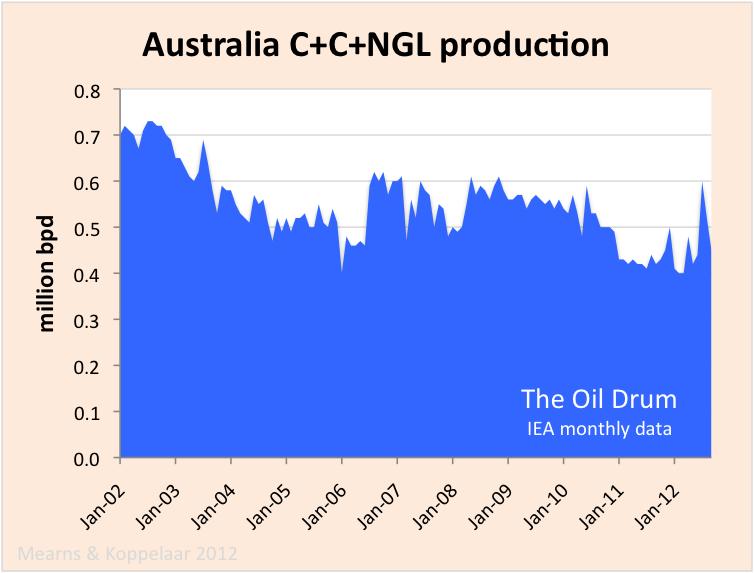
Australia is a small producer which has been in erratic decline over the decade. Recent production has been mainly <500,000 bpd.
3 Comments on "Oil Watch – OECD oil production (IEA)"
BillT on Tue, 4th Dec 2012 1:39 pm
Net is a loss…not a gain. Nothing new here… move on.
Kenz300 on Tue, 4th Dec 2012 3:18 pm
Biofuels can now be made from waste or trash. A lot of trash is produced around the world every day.
All these landfills can now be converted to produce nonconventional oil or biofuels, energy and recycled raw materials for new products. Local energy production and local jobs.
Seems like a good use for all that trash. Much more sustainable than burying it.
GregT on Tue, 4th Dec 2012 3:52 pm
We could continue turning our biosphere into trash to subsidize our fuel addiction, but eventually we would run out of biosphere as well.