
Peak Oil is You

Donate Bitcoins ;-) or Paypal :-)


Page added on November 19, 2012

Peak Oil And The Olduvai Gorge
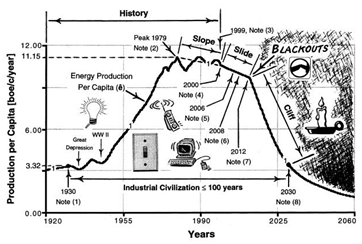
The Olduvai Gorge theory of Richard Duncan was that human society would be forced back to the anthropoid ape stage of evolution by peak oil and energy scarcity, and would live like Tanzania’s “Lucy” the best known precursor or human ancestor, taxonomically called “Australopithecus afarensis”, of about 2 million years ago. Duncan’s angle, developed in the late 1990s, was that peak oil and energy resource depletion would firstly make inevitable, then speed up this retreat and defeat of Humanity, as human society was forced back to hunting and gathering. An Internet search with Olduvai Gorge theory will produce hundreds of responses.
Among the admirers of Richard Duncan and his “back to the jungle” theory, Britain’s Prince Charles and the USA’s Bill Clinton have surely consumed a lot of jetfuel kerosene as well as motor gasoline in their lives, to date, and kept away from hunter gathering, as shown by their ability to avoid paperazzi and photo opportunity hunters. They also kept Duncan’s gory theory of mass human die off and backward evolution to hunting-gathering, due to Peak Oil and fossil energy depletion, out of nearly all of their speeches. As we know, certainly in recent years, the elite fear of peak oil has been replaced by global warming fear – as the best excuse to impose “world government”, unelected of course.
GOOD BYE PEAK OIL
Duncan’s theory was given significant media attention about 10 years ago, and was heavily cited by supporters of the US Gas Cliff theory, promoted by writers including Julien Darley and Michael Ruppert in 2004-2006, and by promoters of Doomsday energy shortage and oil soaring to $200 a barrel, such as Matt Simmons. The Gas Cliff theory, we can note, argued that gas resource depletion was running so fast, that US gas resources would be “practically exhausted” by about 2015. Today, we know that we face a towering cliff of unconventional gas resources – discovered since only 2007. Discoveries of unconventional gas march on and up, implying that probably 200 years, or more, of current world gas consumption are now available as exploitable resources, worldwide.
The keywords conventional oil and gas, and unconventional oil and gas, tell us all we need to know about global fossil energy for the next 50 years, at least. Peak Oil (PO) theory as developed by Colin Campbell, Jean Laherrere and Kjell Aleklett among others, only concerns conventional oil resource depletion, does not in any significant way concern gas resources, and also assumes that global oil demand and consumption can only rise.
The PO theory of the period 1998-2008, during which it had large media, corporate and even political support is easy to compare with M. King Hubbert’s US oil depletion theory of the 1950s: this also was only focused on conventional oil resource depletion on the supply side, and ever-rising oil demand. Hubbert’s theory however attracted little media interest or overt political support, but his theory very probably helped set US Middle East policy of the 1950s – still unchanged today. This is based on the notion of “incompressible dependence”, and possibly near total future dependence on Middle East oil, due to “Soviet oil dependence” being (very) politically incorrect during the Cold War. Oil dependence on Soviet fundamentalists was supposedly a lot worse than depending on Islamic fundamentalists.
Hubbert’s theory was in large part driven out of mass media not by geopolitical cherrypicking, but by the pace and size of oil discoveries in the 1950s and 1960s – world annual discoveries, each year, were often enough to cover more than 20 years of global oil consumption at the time – although US domestic oil discoveries were already declining. Hubbert’s theory, we can note, had hard edged technocratic, even Soviet-style “organized society” ideas about how to control society in face of the coming oil crunch, for example by speeding up the development of nuclear power and of “emergency preparedness”.
PO theory, post 2000, was in particular parasitized by ideological hotheads, such as Richard Duncan or Michael Ruppert who proposed ‘draconian change’ of society and the economy. Actual details on this “survival preparedness” were almost inevitably thin on the ground, but included the well-known, almost traditional call, in urban industrial society and culture, for a return to rural non-industrial lifestyles.
NEW CRISES
The mega-shift from global oil and gas dependence on conventional resources, to unconventional oil and gas resources, has only become so large it is impossible to ignore since about 2005, and especially since 2009. This in major part explains why PO theory’s support and media attention has spiralled down, since at latest 2009. This shift relegates oil and gas depletion to an “historic theory” of the past, and has already been noticed, if not yet acted on by OPEC and NOPEC energy exporters who will have to learn to live with a vastly different global energy context featuring the convergence of energy prices, and lower prices for all forms and types of energy, either fossil or renewable.
In particular this concerns oil, with current (November 2012) prices still around 25% or $25 per barrel higher than any “equilibrium price” for oil energy compared with all other forms and types of energy. Very ironically and as I have pointed out in other recent articles, the elite fear of anthropogenic global warming and linked call for “elininating coal from the energy mix” (or forcing worldwide use of carbon capture and sequestration-CCS), implies continued high, or very high energy prices, simply to pay for this elite folly and policy dream.
In the US where shale gas development has slain gas prices, current prices stand at less than $20 per barrel of oil equivalent, a long way from the $80 – $90 per barrel equivalent charged by Gazprom for pipeline gas supplies to Europe, or by Qatar for LNG exports to Asia. The mega-shift in global gas pricing, towards much lower barrel-equivalent prices will also spillover to oil. Gas-indexing of oil prices is moving forward, stealthwise at present, making for the current total disagreement and lack of certainty among oil and energy analysts as to what “the right price of oil” might be, expect that it will be lower than current prices. Conversely, at least in thoery, coal prices might be raised in order to help finance global CCS, although this is currently unlikely.
Certainly in the 6-month short-term, unless the Middle East geopolitcal scene heavily degrades, which is unlikely but possible, and unless global oil demand “bounces”, which is almost impossible, global oil stocks will tend to go on growing. Oil production capacity will continue growing (including both OPEC and NOPEC capacity), and competing energy supplies at much lower prices, especially gas and the renewables will also go on growing. This however is only the “rational outlook”.
The irrational-but-possible outlook, supposedly “contrarian” is that the need for high-priced oil, by the global financial, trading, asset management, energy fiscal, and both conventional and alternate energy interests and industries is so high that even with the demise of PO, something has to be invented to keep oil prices high. Not a fundamental but treated that way by oil price analysts, US and European fiscal and monetary policy and its spinoff effects on USD/EUR parities and the gold price, create a bundle that is negative for oil prices going forward. The “traditional backstop” for overpriced oil – high gold prices – is under serious threat at this time, despite the supposed outlook for hyperinflation due to QE Infinity. In many ways as dire in its economic impacts, intense deflation is an emerging global macro trend. Gold prices are possibly or probably threatened by major correction, to a more stable price range around $1550 per ounce coherent with oil prices around $60 – $75 per barrel. This may only be a first stage in the “energy asset adjustment” process.
UNRELENTING DEMAND GROWTH
Both Hubbert’s theory, and PO theory post 2000 posited unrelenting growth of global oil demand, but certainly since 2005 or a little later, stagnation of global demand and regional decline of oil demand is the reality. This can rather easily spread to all other forms and types of energy – witnessed by the decline of natural gas demand in Europe, despite the certain prospect of more abundant supplies and lower prices, for a “low CO2 emitter” alternative to coal-fired power.
In the large oil consumer region of Europe, oil demand in 2012 is declining for its sixth straight consecutive year making it harder and harder to brush this off as a “transient trend” only due to economic crisis. Chinese oil demand growth which averaged about 9% a year for 1998-2008 is now set at close to 3.5% a year, with a similar and ongoing fall in oil demand growth rates for India. Energy shift away from oil is a powerful long-term trend. Using IEA data, the OECD group of countries in 1973 obtained about 53% of their total energy from oil; in 2011 they obtained about 35% from oil.
Olduvai Gorge theory may have been exciting, to Prince Charles or Bill Clinton, but other changes have happened and are happening in global energy in a global macroeconomic context that itself is changing very fast. These fundamental changes will continue to build going forward, making for the unsurprising forecast of further decline in oil’s role in world energy, geopolitics and the economy. This role will gradually erode and fade as the oil price starts to converge, at a lower level, with prices for all other forms and types of energy. Like Hubbert’s theory of the 1950s, and the PO theory of 1998-2008, the Olduvai Gorge theory posited ever declining world consumption of oil – dictated by supply side decline. Demand side decline is also possible, in fact current reality, but the mechanism and process of decline and shift, away from oil, are light years away from Olduvai Gorge.
14 Comments on "Peak Oil And The Olduvai Gorge"
Beery on Mon, 19th Nov 2012 1:17 am
I think that to suggest that current reality is based on demand side decline is to miss the big picture. I think it’s pretty clear that the decline is supply based. The suppliers just don’t want anyone to know it, so they cook the books and make it seem like there is no supply problem.
poaecdotcom on Mon, 19th Nov 2012 1:50 am
Yawn…. Every producer is going full tilt save perhaps Saudi and Russia and its a DEMAND problem??!! More countries past peak every year…
I suspect its a EROEI problem.
As cost of oil per barrel increases, so net energy decreases. Social complexity is a direct function of net energy.
Obviously, as the cracks appear in the western level of social complexity so demand falters (where we see today.
“even with the demise of PO, something has to be invented to keep oil prices high.”
Peak oil is hardly a theory ‘subject to demise’….. Its a real life, real time OBSERVATION of finite resource extraction.
autonomous on Mon, 19th Nov 2012 1:50 am
So it’s either a vast conspiracy of elites or speculators that are to blame for high oil prices:
“The elite fear of anthropogenic global warming and linked call for “eliminating coal from the energy mix” implies continued high, or very high energy prices, simply to pay for this elite folly and policy dream.”
poaecdotcom on Mon, 19th Nov 2012 1:57 am
The only way ANY resource extraction will NOT peak is if the natural replenishment rate of the resource is equal to or greater than the extraction rate.
This is mathematics and not up for debate.
Concerned on Mon, 19th Nov 2012 3:26 am
There was a difference between PO in the 1950s an 1998-2008?
Plantagenet on Mon, 19th Nov 2012 5:28 am
Duncan predicted the Olduvai Gorge. Instead we’ve got a global oil production peak, economic depression in the EU, and the fiscal cliff in the USA.
BillT on Mon, 19th Nov 2012 5:33 am
Call it what you will, it is the end of BAU…
Sudhir Jatar on Mon, 19th Nov 2012 8:32 am
What are the reasons for lower demand? As far as India is concerned, there is just no effort to reduce oil’s role in energy and still there is decline in growth of oil demand. This is because the economy is not growing as fast.
Secondly, there is no mention of increased global warming due to use of unconventional oil & gas. For how long will this go on?
In other words, in the longer term, unconventional oil demand will reduce because of environmental concerns.
Overall an excellent exposition of a different point of view to which all might not contribute.
Vipp on Mon, 19th Nov 2012 8:36 am
LOL this article.
actioncjackson on Mon, 19th Nov 2012 3:12 pm
This article misses the mark very badly.
LT on Mon, 19th Nov 2012 5:00 pm
It is obvious that the author tried to ridicule the Olduvai theory without a reasonable reasoning, whereas the Olduvai theory, for me, well written paper. As someone who have been in electrical engineering many years, I hold high regards for the Olduvai theory, in principles, not in time frame. The time frame predicted by Dr. Duncan might be off a bit due to political circumstances; but the general shape of the curve still hold true.
It has been over 7 years since I first read Dr. Duncan’s paper “the Olduvai theory” in spring 2005. And it has not been proven wrong by actual data yet.
The average energy used per person will eventually decrease, due to diminishing of energy resources.
Remember 1: Even miracles are still REQUIRED energy to manifest! 🙂
Remember 2: Electricity is NOT a raw resource. It is highly expensive man-made commodity. It takes a lot of fossil fuels to ‘manufacture’ electricity that we waste daily in our cloth drying machines and other gadgets.
To me, it is easy to simulate peak oil! 🙂
The details are left as exercise for …anyone. 🙂
Arthur on Mon, 19th Nov 2012 6:28 pm
Let’s do a quiz… try to find a hunter and gatherer in this picture from the time before the oil age:
http://www.library.csi.cuny.edu/roccos/art203/pantheon.jpg
Finding Lucy is OK as well.
Send your solution to Olduvai Gorge Management Inc. and CEO R. Duncan will pick the best solution and the winner will get a wooden penis sheath as well as a spear in order to be better prepared for difficult times ahead.
GregT on Tue, 27th Nov 2012 8:45 pm
“I know not with what weapons World War III will be fought, but World War IV will be fought with sticks and stones.”
Albert Einstein
tom on Thu, 8th Dec 2022 1:52 pm
maybe timeframe 10 years later