
Peak Oil is You
Donate Bitcoins ;-) or Paypal :-)


Page added on October 3, 2012

Drilling for oil in the Arctic: the risks are too great for companies to take on
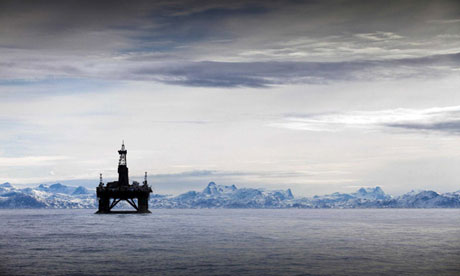
The floating ice cap of the Arctic has been shrinking at an alarming rate for several years, but this year’s melt was truly remarkable. The area of the Arctic Ocean covered in ice in the summer is now just half the size it was when satellite monitoring began three decades ago, with scientists now radically changing their predictions for when the entire ocean will be open water.
It’s refreshing to see that oil industry players, both current and former, have formed an unlikely chorus of collective opinion and are saying that drilling in the Arctic is a bad idea. An analysis of the combination of the cost and the risk of Arctic drilling is leading to the emergence of a new conventional wisdom. If corporate social responsibility (CSR) is to mean anything more than mere branding then there is a line beyond which the oil companies cannot go, and it is a line in the ice.
When we launched the Save the Arctic campaign at Rio+20, I shared the platform with Sir Richard Branson, who spoke eloquently on the urgent need to transition away from carbon fuels. Puma chairman, Jochen Zeitz, was one of the first to sign the Greenpeace Arctic scroll that will next year be planted on the seabed 4km beneath the pole. Nick Butler, the former head of BP’s expro division and Lord Browne’s one-time right-hand man, wrote in the Financial Times that the setbacks Shell has suffered in the Arctic should cause it to pull out.
“To abandon the Arctic project would not be an admission of technical failure, nor an act of submission to the environmentalists. It would be a statement of commercial common sense,” Butler writes.
Also writing about Shell’s Arctic venture, Forbes magazine commentator Matthew Hulbert, said: “There will be another ‘Macondo moment’ at some stage from unconventional plays. It’s just a matter of where, when, and who.” Macondo, of course, was the blowout that nearly crashed BP.
Lloyd’s of London warned companies not to “rush in [but instead to] step back and think carefully about the consequences of that action.” The German bank WestLB announced it would not provide financing to any offshore oil or gas drilling in the region because the “risks and costs are simply too high.” Then last week Christophe de Margerie, chief executive of oil giant Total, made an extraordinary intervention, warning the oil majors that Arctic drilling was bad business. “Oil on Greenland would be a disaster,” he said. “A leak would do too much damage to the image of the company.”
Shell – the company leading the charge into the Arctic – may soon regret not reaching the same conclusions as its peers. It leaves the Alaskan coast this year having made a multi-billion dollar investment that resulted in the drilling of not a single well, after key parts of the company’s infrastructure failed to secure safety permits and the unpredictable ice patterns further disrupted their plans. And in return for its investment the company suffered significant brand damage. It is a catastrophic reputational defeat for the company that invented CSR.
I’ve long thought that www.nsidc.org is perhaps the Internet’s most insightful website when it comes to climate change. The Colorado-based National Snow and Ice Data Center (NSIDC) monitors the size of the cap of Arctic sea ice at the top of the world and publishes a daily updated graph on its site. On the day NSIDC announced a new record sea ice minimum, 350.org founder Bill McKibben was with me in New York, where we held a coordinated international response to the Polar crisis. This is what Bill said: “There’s no place on Earth where we see the essential irony of our moment playing out more perfectly than in the Arctic. Our response has not been alarm, or panic, or a sense of emergency. It has been: ‘Let’s go up there and drill for oil’. There is no more perfect indictment of our failure to get to grips with the greatest problem we’ve ever faced.”
Bill recently wrote an extraordinary piece in Rolling Stone magazine entitled Global Warming’s Terrifying New Math in which he accounted for all the buried carbon that we need to keep in the ground if we’re to safeguard our civilisation. His calculations, which included Arctic oil, were compelling. Thankfully a similar calculation is being made about the risks – economic and otherwise — of drilling in the Arctic. It’s what we call the ‘business case’. A growing number of industry figures are now standing with Bill and with Greenpeace and the nearly two million people who have already joined our Save the Arctic campaign.
There is the now the potential for the birth of a uniquely diverse coalition of civil society groups, industry figures and energy economists all opposed to Arctic drilling. As the winter ice reforms and Shell retreats, we all need to work to ensure this new movement is ready to fight and win when next year the summer melt begins again and the reckless wing of the oil industry once more moves north.
6 Comments on "Drilling for oil in the Arctic: the risks are too great for companies to take on"
Plantagenet on Wed, 3rd Oct 2012 4:49 pm
The pressure to drill in the Arctic increases with every penny the price of oil goes up, and with every factory that is closed and job that is lost in the USA and the EU.
rollin on Thu, 4th Oct 2012 12:05 am
I went to the nsdic site and tried operation icebridge. The site told me that Internet Explorer was not supported, that leavea a lot of people out.
rollin on Thu, 4th Oct 2012 12:12 am
If there is money to be made, the Arctic will be plundered. Just let oil rise another 20 dollars or more per barrel and you will see them solving the problems. Ocean drilling was more expensive and risky and now the rigs are a hazard to navigation. Until governments get some sense and stop the insanity, profits will drive the system.
BillT on Thu, 4th Oct 2012 1:08 am
Perhaps, if we are lucky, the first well will hit a huge pocket of methane and explode, taking the rig and support ships down with it. A huge bubble of released methane from the sea floor would sink everything above it. Kinda like the ocean being pulled out from under them and then crashing back over them. We can only hope.
Newfie on Thu, 4th Oct 2012 5:49 pm
Keep burning oil and the planet is going to fry.
Nuclear on Thu, 4th Oct 2012 5:57 pm
Now you see why we should build more latest safer nuclear reactors which can provide clean green energy.
Infact, the Plugin vehicle sales are increasing and having cheaper electricity will help those who want to cut down oil consumption.