
Peak Oil is You

Donate Bitcoins ;-) or Paypal :-)


Page added on September 23, 2012

First Tidal Power in U.S. Starts Flowing to the Grid
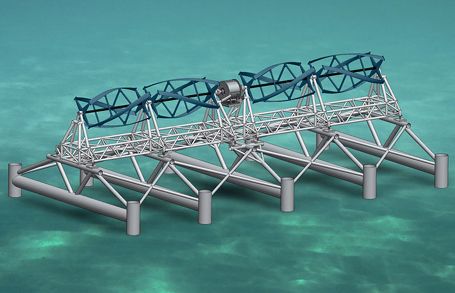
IEE Spectrum reports that a tidal power project has gone live in the US – First Tidal Power in U.S. Starts Flowing to the Grid.
An offshore turbine is finally spinning in the United States! It’s not the kind you’re imagining, but this is a milestone nonetheless: The Ocean Renewable Power Company announced that its TidGen tidal turbines have started providing power to a utility grid owned by Bangor Hydro Electric Company. This marks the first time that any offshore power generation facility has fed electricity back to a utility grid in the United States.ORPC completed installation of one of its tidal power devices earlier this summer in Cobscook Bay, part of the bigger Bay of Fundy, off the Maine coast. The TidGen has a peak power output of 180 kilowatts, enough to power around 25 to 30 homes. The company plans on installing another two turbines in the same location in the fall of 2013, possibly scaling up after that to 5 megawatts of power. That would be enough to power around 1200 homes.
The TidGen device, installed in water depths of 15 to 30 meters, takes advantage of water flowing in and out of the bay as the tides change. The Bay of Fundy as a whole is an enormous tidal power resource; ORPC says that 100 billion tons of water flow in and out of the bay every day, with tidal ranges as high as 15 meters. And tidal power has one advantage over, say, offshore wind energy, in that it is remarkably consistent and predictable. Ocean technologies in general are on the rise of late, such as the progress toward wave power in Oregon. Combined, wave and tidal power have fairly massive potential, up to as much as 15 percent of the U.S. electricity demand according to reports from the Department of Energy. Last year, a Georgia Tech group created a tidal power mapping tool that was validated by the DOE to aid in specific site development and localized resource assessment.
12 Comments on "First Tidal Power in U.S. Starts Flowing to the Grid"
Norm on Sun, 23rd Sep 2012 2:22 pm
Not sure why, but I am a skeptic.
Here is a youtube video for those wanting more information:
http://www.youtube.com/watch?v=HUYJj_qXzy4
They show a couple of ‘Outback’ power inverters…. not a whole lot of power generated really.
How long until the barnacles cover it up? Haven’t they seen what a shipwreck looks like?
I can’t see where the money is flowing. That tells you the real story. Did the money come from a government research grant? Maybe they want to sell you stock shares in their company?
Arthur on Sun, 23rd Sep 2012 3:26 pm
Great news! The message for the future is that we should be thankful for every kwh we can scrape from the bottom of the energy barrel.
Assume it is 1859 again (Drake Well). Instead of oil wells coming into operation, leading to a US peak production more than a century later, these devices are the first that are going to provide us with new energy.
http://en.wikipedia.org/wiki/History_of_the_petroleum_industry_in_the_United_States
It could very well be that it will take again a century to reach a new plateau in energy production, this time however the plateau will be stable.
Kenz300 on Sun, 23rd Sep 2012 3:27 pm
Investments in alternative energy sources continues to climb. Wind, solar, wave energy, geothermal and second generation biofuels made from algae, cellulose and waste are the future. The price of oil, coal and nuclear keep rising while the cost of alternatives keeps dropping with improved technology and economies of scale reducing costs. Safe, clean alternative energy is becoming a greater part off the worlds energy mix every year.
http://www.sciencedaily.com/releases/2012/06/120611092347.htm
BillT on Sun, 23rd Sep 2012 3:39 pm
Another pipe dream. No mention of the cost of installation or maintenance over the next 20 years. I suspect that you and I are funding this dream with our tax dollars and some few people are getting rich.
For less than $1M you could power those same 25-30 homes with solar and wind electric generated on their own property with no infrastructure required. I bet this installation cost way more than that, is less reliable/maintainable, and will fail within 5 years.
Why? Where is the NET energy numbers? How many barrels of oil energy did it take to mine, refine, manufacture, transport, and install this piece of equipment? Can it supply enough energy to replace itself in the future and still be profitable? Capitalism demands profits for something to exist. Again … EROEI?
DC on Sun, 23rd Sep 2012 6:12 pm
That was my first thought as well. Why not simply use wind or solar to power those homes instead? Like you say Bill, lot cheaper, easier to maintain and install. Tom Murphy talked extensively about tidal power, and he came away with ‘niche’ at best. No way tidal would ever come near to 15% of US demand. Even 1% would be an accomplishment! Its not that flowing water insnt an energy source it is! But the Bay of Fundy is a unique location. Wed need 100s of BoF’s and all jammed to the sea-floor with complex gear to make any use of it. And btw, what would a hurricane or typhoon to do a tidal facility? Same thing as it would to a wind turbine or solar array. But which one could be repaired, replaced much cheaper and faster….
Norm on Sun, 23rd Sep 2012 7:04 pm
What Bill said.
Norm on Sun, 23rd Sep 2012 7:09 pm
Also, note the weasel language, ‘peak output up to 25 – 30 homes’. So… what about the minimum output (its 0 homes) and what if you do a sustained average…. 2 homes? Not a good output, for this relatively large expensive and short-lived thingy ma jingy. Notice in the youtube video…. for some reason they had 2 outback power inverters. that might only be enough conversion for 1-2 homes.. :O( BillT said maybe taxpayer dollars paying for it…. yep… life is good for the government funded researchers. I will put in a grant request, $850,000 funding to generate energy by burning up old running shoes in a 55 gallon drum. My salary $185,000 a year for 3 yrs duration. LOL thats how it works.
Arthur on Sun, 23rd Sep 2012 7:11 pm
The density of water is 1000 times higher than that of air, so with equal flow velocity, the resulting power is 1000 times higher per rotorblade area. Unlike windenergy, the potential number of locations where this kind of power can be harvested, is limited. So if you can find such a location, use it! No energy form is more desirable, cleaner, reliable, than hydro energy.
SOS on Sun, 23rd Sep 2012 9:24 pm
This was my first thought too, what a waste. This will be the most expensive power those 1,200 homes will ever use. I bet the project is swamped in ridiculously high maintenance that will shut it down.
All you have to do is properly develop, in an orderly fashion, Americas vast conventional energy resources. We have far more than enough. Its just politics of shortage that keep this situation alive.
If we hadnt slowed or stopped development in the 1970’s we wouldnt need the Middle east and all the army and navy forces to keep it flowing now. We would be using our own resources. Developing our own wealth not transfering it to others.
We can still do that with the proper plan. One of the candidates for president has proposed a plan for North American energy independance by 2020. Its a good plan for everyone.
Nuclear on Sun, 23rd Sep 2012 11:27 pm
Wonderful. The World’s 1st model wind turbine built in Denmark had only 22 KW. Today’s wind turbines have 2,000 – 6,000 KW.
I hope the improvised version of these will provide power in Megawatts.
There are vertical axis wind turbines which have the similar design, the same is submerged in sea a tidal turbines.
Infact some companies are installing sub-sea wind turbines. In all, Wave power is becoming another potential powerhouse like Wind, Biofuels, Solar.
Also I wonder why the writer is so poor in calculations. 1 average american home consumes 3 KW, so 180 KW / 3 KW = 60 homes can be served by this turbine and not 25-30 as they mentioned.
And if the American home uses LED bulbs and energy efficient appliances, it should consume only 2KW of capacity.
Arthur on Mon, 24th Sep 2012 9:27 am
Average electricity consumption of a household in the Netherlands is 3480 kWh per year or 3480/(365*24) = 397 Watt on average. I know that Americans use more energy but I do not believe it is 3000 Watt as Nuclear claims. So the installation discussed here can service 180 kW / 0.4 KW = 450 Dutch households during the peak and maybe 225 permanently with a buffer.
Eliza Sanchez@oil flow meter on Wed, 3rd Oct 2012 8:07 am
Well done for all your hard work in providing this high quality blog.Thanks for the information.