
Peak Oil is You

Donate Bitcoins ;-) or Paypal :-)


Page added on September 23, 2012

Global oil exports in decline since 2006: What will importing nations do?

It is with trepidation that independent petroleum geologist Jeffrey Brown has watched global oil exports decline since 2006. With all the controversy in the past several years over whether worldwide oil production can rise to quench the world’s growing thirst for petroleum, almost no one thought to ask what was happening to the level of oil exports. And yet, each year a dwindling global pool of exports has been generating ever greater competition among importing nations and has become a largely unheralded force behind record high oil prices.
Even though the trend in oil exports has been evident in the data for some time, the analyst community was caught by surprise when a Citigroup report released earlier this month forecast an end to oil exports in 2030 from Saudi Arabia, currently the world’s largest oil exporter.
Brown, as you might expect, wasn’t surprised at all. His own forecasting model, which he calls the Export Land Model, has been predicting more or less the same thing for some time. He doesn’t think the Saudis will actually let exports to go all the way to zero because they’ll probably want at least some revenue from exports. But “one to two million barrels per day of exports [from Saudi Arabia] between 2030 and 2040 will not be a big deal in the world,” said Brown, who runs a joint venture exploration program based in Ft. Worth.
Brown estimates that worldwide net exports of petroleum liquids–a number that includes both crude oil and refined products such as gasoline and diesel–declined from 45.6 million barrels per day (mbpd) in 2006 to 43.7 mbpd in 2011. He uses the net exports number because importers such as the United States export some of the crude they import back into world markets in the form of refined products such as gasoline and diesel. Even so, the United States remains the world’s largest net importer of petroleum products.
The decline in global net exports may seem small for now. But it is persistent and comes in the face of growing demand among the rapidly expanding economies of Asia, particularly China and India. And the trendlines, if they were to continue, would mean that China and India alone would consume all the world’s available petroleum exports by around 2030. Something’s bound to give before then, but it’s not clear what.
Brown focuses on a key number which he calls cumulative net exports (CNE). It’s the total expected volume of exports from oil-exporting countries over the entire period from now until global exports are presumed to drop to zero around 2060 based on the trajectory established in data from 2005 through 2011. Though the timetable is likely to change, when he looks at CNE alongside the current rate of decline for exports, it’s clear that the world’s remaining exports are “front-loaded.” The largest portion will be delivered in the years immediately following the export peak.
“A rough, but fairly consistent rule of thumb is that half of post-peak CNE tend to be shipped about one-third of the way into the net export decline period, which suggests that post-2005 global CNE would be about half gone around the year 2024,” he explained. It’s why “we’ve experienced something close to business as usual” since the apparent export peak in 2006, he added. That tells him that the economic pain associated with the loss of global exports is likely to become very acute in the not-too-distant future.
If this happens, the world will be forced to adjust. But that adjustment is likely to be rather wrenching for some. Already, consumers in the United States, for instance, have actually partly accommodated rising demand in Asia by reducing U.S. consumption of oil products from 20.8 mbpd in 2005 to 18.8 mbpd in 2011. But the cutback has been largely a matter of necessity for those who have lost jobs or experienced wage cuts and for businesses which are struggling in a weak economy.
As Brown began to think about the export issue back in 2006, he made two observations which seem obvious once you hear them: First, if the economy of an oil-exporting country grows, that country typically will use more oil to support that growth. Second, once total production peaks and starts to decline in an oil-exporting country, exports almost always decline much faster than total production. This is because exports are typically being squeezed from two sides. Production is falling making less oil available for exports, and consumption is rising with the same effect. (Declining net exports can also occur if domestic consumption is rising faster than production which is what happened in the United States, causing the country to become a net importer for the first time way back in 1948.)
The two observations above led Brown to develop what he dubbed the Export Land Model. It was a simple model that seemed to explain a lot. Here’s how he set up his first case: Brown assumed that a hypothetical oil exporter–which he designated as Export Land–had reached its peak in oil production. He assumed that domestic users in Export Land consumed half of all the oil the country produced. He then assumed a 5 percent annual decline in the rate of oil production and a 2.5 percent annual increase in domestic consumption. The results astonished and troubled him. In just nine years oil exports from Export Land went to zero.
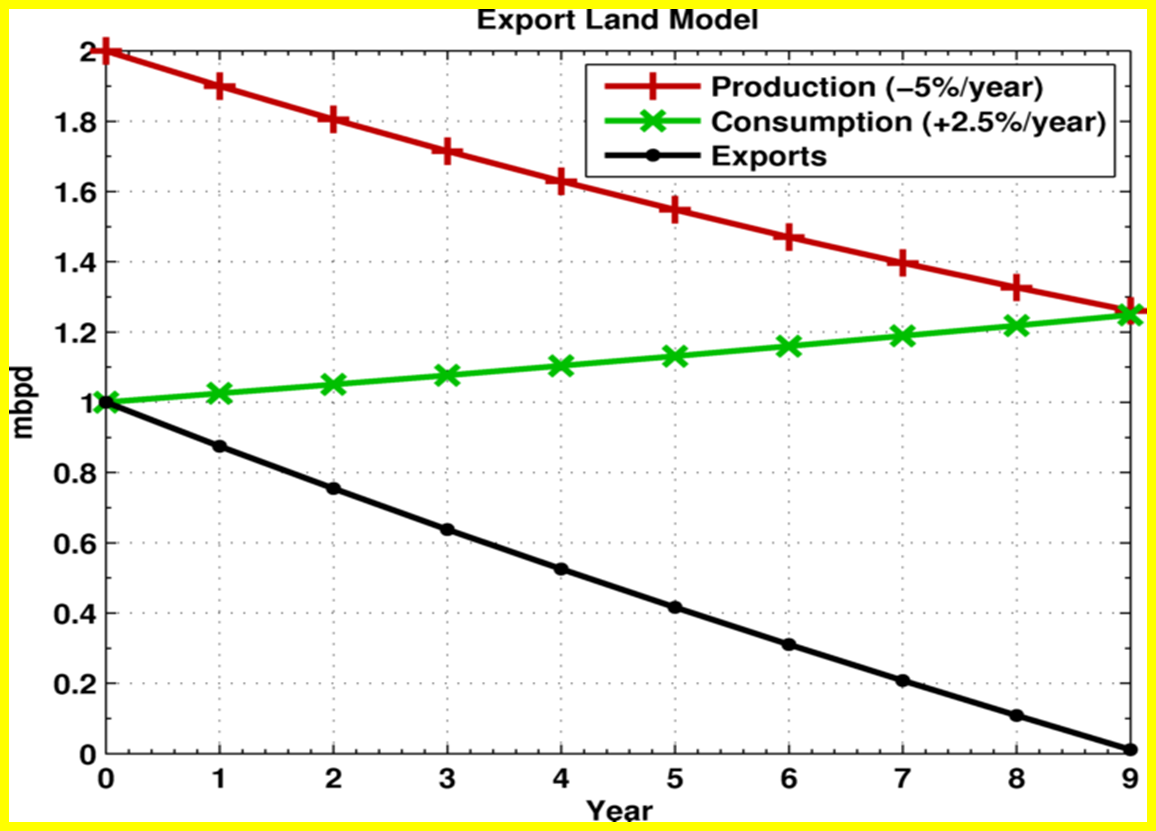
He then tried the model out on two real world examples, the United Kingdom and Indonesia. Both countries were consuming about 50 to 60 percent of their own oil production at the time their production peaked, close to Brown’s hypothetical case. But the U.K. had a higher production decline rate, -7.8 percent per year and a very modest 0.2 percent annual growth in oil consumption. Indonesia had a lower production decline rate than the hypothetical case, -3.9 percent, but a higher yearly increase in domestic oil consumption, 4.1 percent. Despite these differences, the results were quite similar to the hypothetical case. From its 1997 peak in oil production, Indonesia’s net exports took only seven years to fall to zero. From the U.K.’s oil production peak in 2000, it took only six years for net exports to approach zero.
| Country/Prod. or Exports |
Peak Production Year
|
Year 1
|
Year 2
|
Year 3
|
Year 4
|
Year 5
|
Year 6
|
Year 7
|
Annual Decline Rate
|
| UK Production |
2,909
|
2,667
|
2,476
|
2,463
|
2,257
|
2,028
|
1,809
|
1,636
|
-7.8%
|
| UK Net Exports |
1,180
|
963
|
772
|
763
|
534
|
262
|
3
|
-152
|
-55.7%
|
| Indonesia Production |
1,580
|
1,557
|
1,520
|
1,408
|
1,456
|
1,387
|
1,289
|
1,176
|
-3.9%
|
| Indonesia Net Exports |
657
|
531
|
539
|
384
|
300
|
249
|
105
|
-34
|
-28.9%
|
All production and net export figures in thousands of barrels
After modelling these two real world examples, Brown and his colleague Sam Foucher began tracking petroleum exporting nations with more than 100,000 barrels per day of exports (based on 2005 data). These 33 countries represented 99 percent of the globe’s net exports at the time. Strangely, no official energy agency calculates global net exports. So, Brown and Foucher have had to compile data from the U.S. Energy Information Administration, the statistical arm of the U.S. Department of Energy, and the BP Statistical Review of World Energy, a widely cited annual survey produced by oil giant BP. By the end of last year, six of the original 33 countries–the United Kingdom, Indonesia, Egypt, Vietnam, Malaysia and Argentina–had dropped off the list. Of those only Egypt had any exports at all, about 26,000 barrels per day. The rest of the countries had become net importers.
“We’re losing one major exporter per year,” Brown said. He expects that rate of loss to continue. He added that as a group, oil production in the 33 countries he tracks has hit a plateau, bouncing between 61 and 63 million barrels per day since 2005. If total production from exporting nations starts to fall, look for an acceleration in the decline of net exports. (Total worldwide oil production also appears to have been on a bumpy plateau since 2005.)
Brown said importers around the world are already being forced to respond to an ongoing decline in net exports. “We are on our way to energy independence,” he joked. “Just not in the way that we expected.” The United States and other developed countries are now being outbid by the developing world for oil and ending up with a declining share of a declining supply of exports. “While the recent rise in U.S. production will help, it will not save us,” he added. That’s because the rise is too modest to put much of a dent in imports which have declined primarily because Americans have simply cut back their consumption of gasoline and other petroleum products.
10 Comments on "Global oil exports in decline since 2006: What will importing nations do?"
Kenz300 on Sun, 23rd Sep 2012 3:20 pm
Oil imports have gone from 60% of total oil consumed to 40% of oil consumed in the US in the last four years. The US is now increasing oil production (slowly but steady.) Increased energy efficiency, higher CAFE standards(40 MPG is better than 20 MPG)and alternative fuels substitution are resulting in declining overall demand. Electric vehicles, hybrids, flex-fuel, CNG and LNG cars and trucks are becoming more common. The recession, tight family budgets and consumers making changes in their buying habits by prioritizing fuel efficiency have all contributed to the decline in oil consumption. Many people are even opting to walk a little more, ride a bicycle a little more or take mass transit. Every country needs to develop a plan to become more energy self sufficient. Its economic future and national security will depend on it. We are slowly changing our energy consumption habits. Higher oil prices will force changes on those that do not change willingly.
Arthur on Sun, 23rd Sep 2012 3:33 pm
OK, so ASPO was right all along:
http://www.peakoil.net/Aleklett/2004Scenario.jpg
Since then we have a little (big?) bonus from shale/fracking added to the equation, giving us a little more time. But not much. Besides it is likely that major shortages in oil supply will come from man made troubles (war) first rather than from geological restrictions.
BillT on Sun, 23rd Sep 2012 3:50 pm
It appears that Americans will soon be walking a lot more and driving a lot less. This is not news to some of us. Asia will buy oil at $200 but the US won’t. Why? Because $100 oil is already breaking the backs of most Americans.
Why can Asia afford $200 oil? Because they get more work out of those barrels. They don’t drive SUVs with one person in them. They use more motorcycles and smaller trucks/cars/buses. Here in the Ps, a jeepney may have 15 passengers in a vehicle the size of a large SUV. Or 3+ on a motor bike/cycle. Trucks carry full loads, not one small item and deliver in the city at night when there is less traffic to slow them down, which burns more fuel.
DC on Sun, 23rd Sep 2012 6:04 pm
Demand destruction, ie, your out of work, will help slow this process somewhat, but the end result will be the same. Look at what would happen should the drive-shop-consume-build matchstick and PVC shacks in N.A. magically ‘recovered’. Actual demand would go up, thus speeding up the Export Land crunch time,(since asian demand would also go up). But so would the price! Which would in turn knock down any ‘recovery’ and restore the orginal timing of the Export model.
OR
Demand destruction continues, and this would tend to slow the trend a little. Except, someone, somewhere will buy the oil ‘freed’ up. The US tends to think only they matter when it comes to oil imports, but the truth is Export Land doesnt care *who* is buying the oil, only that someone, somewhere is.
In the End ELM seems to be saying we cant have a ‘recovery’ without running down the resource even faster than his numbers show now(ie collapse lies that way), or we wreck the environment trying to extract tar-gas(ie collapse), or we get oil price spikes which wreck the SUV economy(that would be a good thing actually). But in the end, it doesnt really matter what happens because in a few decades, there wont be much oil to export anyhow!
As to the authors question of what will importing nations do? We allready know the answer to that in one case(the US of terror), what they will do is use there own shrinking domestic production to try to take oil by force from those that still have some left if they wont be threatened into giving it up w/o a fight(unlikely). But this tactic will fail, no matter how advanced the US fragile weapons systems are in 2020, or 2030. Germany in WW2 had arguably better military technology than the US and Russia, but still lost because they literally ran out of gas. So it will be for the US when it tries to move its 2 gallon per mile tanks and helicopters and jets all over the world to ‘liberate’ the oil it thinks belongs to them. The US war machine too, will literally run of gas to fuel its hugely in-efficent war-machines as they try to race around the world stealing oil where0ever they can. They will attack the ones that cant fight back at first, but eventually, they will have to fight people that have more oil than they do, and, and have weapons more than sufficient to the task of defeating amerika.
njparkin on Sun, 23rd Sep 2012 8:14 pm
Good article. Understanding the power of the exponential function is a flaw in human understanding. $200 barrel oil will hurt everyone not just the US.
SOS on Sun, 23rd Sep 2012 9:34 pm
Actually, the USA has had to become an importer of conventional resources because of policies coming from the left. These policies have curtailed domestic production in favor of off-shore “assests”, importing. This requires a huge military and everthing that goes with it.
Follow a policy of developing our vast domestic resources and we wont need a military in the middle east.
MrEnergyCzar on Sun, 23rd Sep 2012 10:24 pm
I’ve noticed a lot of scooters the past year, same in 2008. This is why Asia can handle high oil, they use it wisely…
MrEnergyCzar
kiwichick on Mon, 24th Sep 2012 2:08 am
hi sos
where do you get those drugs?
you should sell some , they are obviously amazing
BillT on Mon, 24th Sep 2012 2:13 am
I think they are something he grows in the Dakotas. Probably uses contaminated water from fraking.
` on Mon, 24th Sep 2012 5:52 pm
The slowing production of conventional resources begining under Jimmy Carter was politically motivated. The result of these politics of shortage was increasing imports. That of course led to armies in the Middle East, the clash of cultures and what we have now under this Administration.
Its an infortunate truth the left has to accept. The violence and wars coming from the politics of shortage preached and practiced by the left are to be sure unintended consequences, but they are at the feet of the those that support those politics.
I dont support them. I support self reliance, development of resources, betterment of the human condition, clear, compasionate thinking. I support an even playing field for all of us. I support an enrgy independent North America by 2020.
As far as scooters go Buddies (made in Chicago) by Genuine are real nice. Very hard to find used ones. If you are driven by economy you should have one. If space is a consideration they dont take up much room, easy to park and maneuver.
Be careful though, I hear those scooter folks have funny cigarettes!