
Peak Oil is You

Donate Bitcoins ;-) or Paypal :-)


Page added on August 12, 2012

World Fresh Water Maps
Fresh water is a fixed quantity. Population and water usage per capita are rising quantities. When the demand exceeds supply, various forces come into play: allocation by price and affordability, efficiency changes, investment in desalination, legal disputes and at some point wars.
Total world consumption of fresh water currently exceeds the replenished amount. The difference is being made up by (1) draining fresh water lakes, and (2) drilling into geologically trapped water that is not replenished. Once those are fully tapped, people hit the wall, and something altogether new has to be done with and about water in their area.
What also is in effect now and will increase over time is the exportation of water, not by shipping water itself, but by growing food in water rich countries and exporting the food (and by indirection the water) to water poor countries.
This is one reason that we like the idea of investing in palm oil plantations, which exist in tropical areas with high rainfall and abundant water. We like Brazilian farms too, where soybeans and other foods are grown in quantity. The problem there is that public farming companies with Brazil operations, tend to have substantial Argentinian assets, and anyone who own strategic assets (such as oil or land) in Argentina is a sitting duck for nationalization).
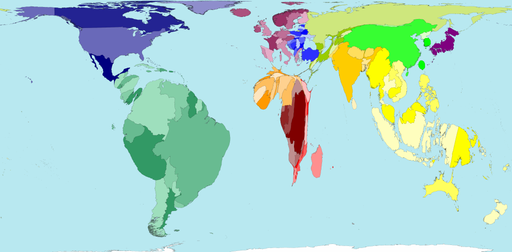
Parts of South America and Southeast Asia are particularly blessed with water resources. The oil rich Middle East is below the water poverty line. Currently oil producing Middle East countries are effectively trading oil for water.
There are about 43,600 cubic kilometers of obtainable rain replenished freshwater on earth per year, but that is less than 1/2 of total rainfall. The balance evaporates or is otherwise unavailable, and once it makes it to the sea, it is no longer fresh.
Map of the World With Countries Sized by Rainfall Amount:
(source: WorldMapper.org)
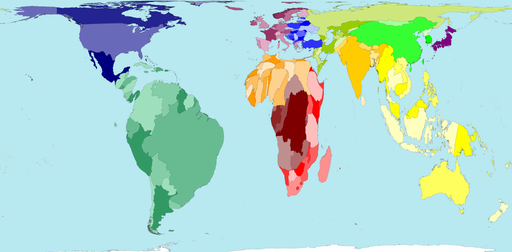
Map of Countries By Total Fresh Water Resources:
(source: WorldMapper.org)
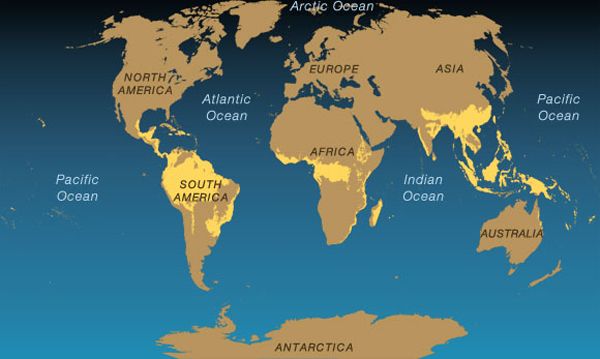
Map Showing Location of Tropical Forests Around the World
(source: National Geographic)
By Richard Shaw
http://www.qvmgroup.com
Richard Shaw leads the QVM team as President of QVM Group. Richard has extensive investment industry experience including serving on the board of directors of two large investment management companies, including Aberdeen Asset Management (listed London Stock Exchange) and as a charter investor and director of Lending Tree ( download short professional profile ). He provides portfolio design and management services to individual and corporate clients. He also edits the QVM investment blog. His writings are generally republished by SeekingAlpha and Reuters and are linked to sites such as Kiplinger and Yahoo Finance and other sites. He is a 1970 graduate of Dartmouth College.
4 Comments on "World Fresh Water Maps"
bobinget on Sun, 12th Aug 2012 8:39 pm
Try growing anything but native fruits and indigenous
animals in a rain forest. Try it w/o pestacides and it’s almost impossible.
Insects OWN the fragile landscape.
Before mass immigration, Florida’s Everglades, like a sponge, was water storage for all of south Florida.
Drained for farming, roads and houses that is no longer the case.
Almost all the world’s rain forests will meet the same fate.
dissident on Sun, 12th Aug 2012 9:57 pm
worldmapper.org produces some howlers when they plot world GDP by country with their maps. I would take these water maps with a grain of salt the size of a house.
Frank Kling on Sun, 12th Aug 2012 10:54 pm
“We like palm oil plantations.” Who the hell is we. Apparently the author has given no consideration to the stripping of the world’s equatorial rain forests to make way for these massive operations. As a consequence mankind has ushered in a Sixth Mass Extinction- more flora and fauna are being driven extinct as due to the continuing metastases of mankind than at any other time in the past 67 million years.
Yes, sooner rather than later we will have hell to pay for this wanton destruction.
BillT on Mon, 13th Aug 2012 2:04 am
Water…lack of, is killing the US Midwest, central Australia, and much of Europe.
Water…excess of, is hurting the S.E. Asian countries to some extent but only in flood zones.
There is no surface water in the US that is safe to drink. Even drilled wells have been contaminated by nitrogen fertilizers used in excess by farmers. Now fraking is adding to the mix.
The farm area we are building in has fresh water springs that ARE drinkable with no contaminants. That is worth more than the view, which is beautiful.
Where is this? The Pacific coast of the Philippines. Why no contamination? No industry, for over 50 miles downwind from the property (Manila), and there NEVER has been any. No over fertilized fields, little automobile use, no chemicals used by business or homes. Nothing but a few small farms and people living mostly off the land.
The comment that rain forests cannot produce a variety is wrong. I doubt that person has ever been in a rain forest. They don’t exist in the 48 states. We will be growing all of the things that do not require a winter. That is far more fruits and veggies than any other climate can produce, and we can do it year round. Plenty of rain, no freezing cold or 100 degree heat. And you can grow all the food you need on a few acres.
BTW: Insects will soon be a problem in the US when the oil based insecticides go away. Wait and see. Why? Because Americans have killed the insect’s natural enemies with those same insecticides and poisons and now the bugs will be free to explode on the scene and wreak havoc in your garden.