
Peak Oil is You

Donate Bitcoins ;-) or Paypal :-)


Page added on August 5, 2012

Tech Talk – an introduction to China

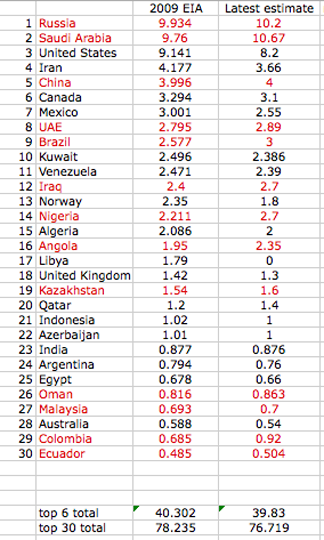
When I first began this review of future production from the different oil producing countries about fifteen months ago, I produced this list of the relative performance of the top 30 producers.

China’s supply is expected to average 4.22 mb/d in 2012, an increase of 80 tb/d over 2011 and steady from the previous month. China’s output in May averaged 4.19 mb/d, also steady from the previous month and the same month last year. However, cumulative production till May 2012 indicates a decline from the figure for the same period in 2011. This has been mainly due to the shutdown of the Penglai field, while healthy production from the Changqing field, which reached a record level in May after 40 years of operation, has partly offset the decline.
As the initial table above shows, China has been lagging Iran in production, but even as China has grown production, that in Iran has slipped. OPEC reports that (again depending on who one believes) Iran is producing between 2.96 and 3.76 mbd. (The latter is the Iranian number). Iraq is still running either slightly ahead or behind at 2.98 mbd. Iran may therefore be moving from 4th to 6th in production rank.
Even as China’s production has crept up, and against an EIA estimate of 20 billion barrels of reserves, these numbers are being dwarfed by the rate at which demand is rising.
As the demand for fuel for China has increased over the past decade, the country has been assiduous in seeking resources abroad which can provide future supplies. Although at present some of these resources are selling to other markets their products can be “swopped” for that from other sources which can be diverted to China. (Nexen which CNOOC has just moved to acquire produces 213 kbd.) It is worth noting the comment that:
the acquisitions will help China “lower the risks when energy shortages become an urgent problem in the global market.”
Also this week Sinopec bought into 8% of the production from the United Kingdom (1.8 boepd) as it purchased 49% of Talisman.
China still gets most of its energy from coal, (71% in 2008 according to the EIA review)

Oil and natural gas are more easily transported in pipelines, though the large distances and the mountainous terrain in regions of the country does not make that construction easy. China has, however, been willing to invest in such pipelines to gain access to, for example, natural gas supplies from Turkmenistan. Until the advent of the pipeline in 2009 the Turkmen were stuck with having to sell their natural gas through Russian pipelines into Europe, and had to take the price that they were allocated. With the opening of a second market, this was foreseen as a considerable boost to both countries. However there have since been some further negotiation of price, as the global market has changed. Those negotations are now complete and flows will increase to some 65 billion cubic meters/year (bcm/yr). It is anticipated that this will cut the need for China to import additional volumes of natural gas from Russia. To date some 20 bcm have been shipped from Turkmenistan through the 1,830 mile pipeline since it opened in 2009, and field development in Turkmenistan is proceeding to provide the volumes required by the new agreement.
In terms of their own resources China has a number of large oil fields, ownership of some of which (the offshore ones) is not always completely agreed.
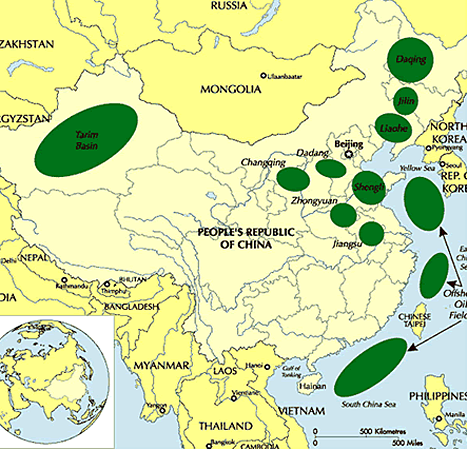
As with oil China has significant quantities of coal, but still imports large quantities from abroad to meet the distributed demand across the country. It is not used purely for electric power generation, in the far West houses are transforming from mud brick to baked brick, with all the local brick works fired by coal, in a region which otherwise gets its power from hydro-electric plants.

One Comment on "Tech Talk – an introduction to China"
BillT on Sun, 5th Aug 2012 12:20 pm
Is someone trying to justify their paycheck with this piece? Where is the news? What was the point? We all know that China is importing all of the resources it can buy with it’s Walmart dollars before they turn into Charmin. We also know that China has untapped resources of it’s own. It appears that China is looking out for the Chinese, not the rest of the the world, a lesson the Empire could use.