
Peak Oil is You

Donate Bitcoins ;-) or Paypal :-)


Page added on July 17, 2012

Oil: Only part of the Arctic’s massive resources
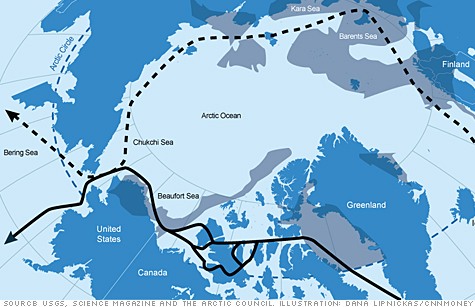
When Royal Dutch Shell sinks five wells off Alaska — slated for next month — it will be the first drilling in U.S. Arctic waters in decades.
Yet it will be just the latest in a slow-moving but steady push to tap the Arctic’s vast natural resources.
Encouraged by high commodity prices and shrinking sea ice, everyone from Big Oil to the cruise industry is eager to get in on the Arctic’s riches.
Oil and Gas: Perhaps the most high profile of the Arctic’s natural resources, oil and natural gas also seem to be the most plentiful.
Nearly 13% of the world’s undiscovered oil reserves and 30% of its undiscovered gas reserves lie north of the Arctic circle, according to the U.S. Geological Survey. That’s 90 billion barrels of oil and 1,670 trillion cubic feet of natural gas.
Those estimates don’t even include so-called unconventional oil and gas deposits such as hydrocarbons found in shale rock or methane hydrates on the sea floor — which are basically crystals filled with natural gas.
Finding themselves increasingly locked out of resource-rich nations such as Mexico, Venezuela and Saudi Arabia, the world’s major international oil companies are eying this potential Arctic bounty as a source for future growth.
Shell’s Alaska operations are garnering most of the headlines this summer, but the U.K.’s Cairn Energy is already drilling off the coast of Arctic Greenland.
Norway’s Statoil (STO) is exploring in the Barents Sea, where Chevron (CVX, Fortune 500) also has leased acreage. And Exxon Mobil (XOM, Fortune 500) has struck a deal with Russia’s Rosneft to drill in the Arctic off the Siberian coast.
These and other deals have been announced in rapid succession over the last few years. But actually producing sizable quantities of oil from the Arctic will be a long, slow process.
The region is utterly lacking in the infrastructure needed to build oil wells and move crude out: pipelines, deep water ports, airstrips, housing. Even which counties own what resources is in dispute.
Dealing with the shifting Arctic ice is another challenge.
Greenpeace to monitor Shell Arctic drilling with submarines
The pressures created by massive ice sheets could crush traditional oil field equipment. Even subsurface pipelines and well heads could be obliterated by a deep iceberg moving in the shallow Arctic waters off Alaska.
“There needs to be an evolution of technologies,” said Surya Rajan, an oilfield technology analyst at IHS Cambridge Energy Research Associates.
It’s not at all certain extracting this oil and gas can be done without significant damage to the natural environment and the livelihoods of the people that inhabit the region.
So for now, Arctic oil development will proceed at a slow pace, in shallow water with drilling mostly confined to summer months — much as Shell (RDSA) is planning with its Alaska wells.
Even if Shell strikes oil next month, those wells would not be producing oil for several years. It may be a decade or more before major amounts of oil or gas flow from Arctic waters.
Shipping: The melting Arctic is creating a tantalizing prospect for shipping companies: Keeping the northern sea passage between Europe and Asia permanently open.
For decades ships have been able to traverse the Arctic along two sea routes. One hugs the Canadian coast and the other along the Russian side.
Obama to allow more Arctic drilling
These routes can cut the distance between Northern Europe and Japan nearly in half, according to a report by the Arctic Council, an organization made up of the eight Arctic nations and other stakeholders. Some estimate it could shave a millions dollars in costs off each trip.
Arctic voyages could previously only take place during a short window in the summer, and often required expensive and scarce icebreakers to accompany the ships.
That may be changing.
Many scientists now estimate that the Arctic could be permanently ice-free in the summer by 2030.
That could make the Arctic passable year round, and without requiring the services of an icebreaker.
Minerals and fish: In addition to oil and gas, the Arctic is is thought to contain world-class reserves of iron ore, zinc, nickel, gold, uranium, and other minerals.
Already, the world’s largest zinc mine is in Arctic Alaska, while the largest nickel mine is in Arctic Russia. One estimate in a Geological Society of London paper said the mineral value in Russia alone could exceed $2 trillion.
Fishing is also an important resource in the region, and could grow as more waters become accessible and species such as cod migrate northward.
Clearly, there will be expanding uses of the Arctic as it thaws.
Whether humans can successfully tap these resources without further damaging the environment, and whether Arctic riches will offset the likely substantial costs imposed by global warming elsewhere on the planet, is another matter entirely.
7 Comments on "Oil: Only part of the Arctic’s massive resources"
BillT on Tue, 17th Jul 2012 1:00 pm
And one unusually cold winter locks it all up for 6 months, shutting down everything.
Richard on Tue, 17th Jul 2012 3:48 pm
Sounds good, but the perils of this endevour must be thought through. But knowing human nature, lifestyle and profit will come first.
oilforbreakfast on Tue, 17th Jul 2012 8:08 pm
“Nearly 13% of the world’s undiscovered oil reserves and 30% of its undiscovered gas reserves lie north of the Arctic circle, according to the U.S. Geological Survey.”
Pardon me but HTF do we know where the world’s “undiscovered” oil and gas reserves are?
draffen on Tue, 17th Jul 2012 8:29 pm
I wonder where the remaining 87 percent of these “undiscovered oil reserves” is located…
Bor on Tue, 17th Jul 2012 9:09 pm
“Many scientists now estimate that the Arctic could be permanently ice-free in the summer by 2030”.
It is going to be ecological disaster on massive scale. Tundra will generate astronomical amount of methane – just to name one “wonderful” component.
SOS on Wed, 18th Jul 2012 2:18 am
Some infrastructure, hysteria aside, is in place. Energy development in the Arctic has been moribund in the politics of peak oil. The Alaska pipeline was developed with excess capacity planning on on-going development. The politics of peak oil stopped that and now the investment is beginning to turn sour because of lack of new crude to pipe to the shipping terminals in the south.
New Artict discoveries, American or not, are going to bring the production to the Alaska Pipeline. This is a good thing and will keep costs down. It will also keep these new, huge, reserves flowing into the USA.
Kenjamkov on Thu, 19th Jul 2012 2:32 am
Good luck building pipelines on permafrost that is soon to be not-so-permafrost.