
Peak Oil is You

Donate Bitcoins ;-) or Paypal :-)


Page added on July 17, 2012

Electric freight transport
Electric bicycles, scooters and cars are getting to be a normal sight in traffic. The developments happen very fast, and more and more people use some form of electric transport. One area that remains behind in that respect is electric freight transport. Experiments are carried out with freight trams in city centres here and there, but so far the system hasn’t grown to be an operational system anywhere. That’s a shame, because in heavy inner city start-stop traffic fossil fuel-powered lorries burn an unnecessary amount of fuel and cause local air pollution. For inner city use the relatively short range is usually not a big problem, but the high purchase price is. It’s likely to just be a question of time before ever stricter emission restrictions in inner cities, together with increasing fuel prices, will stimulate electric freight transport in whatever form.

For medium and long distance freight transport it’s different. The current generation of batteries cannot store enough energy to make that practical. Hydrogen and biofuels may play a role in that arena, but both have their own problems with regards to infrastructure, the possibility to scale up and sustainability.
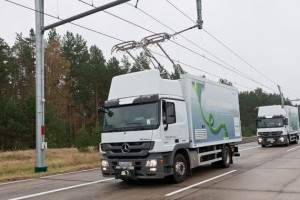
Constructing the infrastructure for this won’t be cheap, but probably cheaper than constructing a rail network or batteries for a whole fleet of lorries. This system also offers flexibility; if a lorry has to leave the electrified route for whatever reason (an obstacle on the road, a sudden change in destination of the freight) that can be done on diesel. Once the infrastructure is there it’s a small step to construct a number of modern trolleybuses using the same system.
The video below shows how the lorry can switch between electricity and diesel at the press of a button by the driver, without stopping:
This animation shows more or less the same.
I think this an intriguing concept. I think it will be a while before this is turned into an operational system somewhere because it suffers from a typical catch-22 problem: it only becomes beneficial to purchase these trucks when there is a sufficiently developed infrastructure for them – but without a sufficient number of these trucks on the road developing such an infrastructure is going to be very expensive. Here lies a pioneering task for the government. Possibly a large harbour area could be an attractive test area, as that represents a relatively compact area with high transport needs.
6 Comments on "Electric freight transport"
BillT on Tue, 17th Jul 2012 12:44 pm
Yes, the cost of these ‘ideas’ will prevent most from ever getting beyond dream stage. The system we have now was built over 100 years and was at a time of increasing energy and wealth. Not so now. Too much to change with too little resources to divert to such a massive revision. Adjust.
Kenz300 on Tue, 17th Jul 2012 4:54 pm
We once had electric trolleys in cities across America. The oil industry and GM pushed to replace them with cars.
We need a greater mix of alternatives for transportation. Walking, bicycling and mass transit are options that need to grow. More safe bicycle and walking paths that connect work, school, businesses and homes would be a good place to start.
The price of oil continues to go up over time taking more and more of family budgets. We need alternatives.
James on Tue, 17th Jul 2012 9:23 pm
This all good for NOW. However, as the need for Copper, Lithium, and rare earth metals increases. The resource limits will begin to show their ugly faces. China has already stringently limited the exporting of rare earth metals. The U.S. says it can make up for the shortage by re-starting old mines. Why did the U.S. close these mines in the first place? The reason is that we thought we could get the stuff cheaper from other countries, and our mines aren’t that well endowed.
DC on Wed, 18th Jul 2012 2:59 am
Hey, ‘advanced’ batteries are another capitalist scam. We dont not require RE, or even lithium to run an electric local goods transport system. TPTB, love high-tech batteries precisely because they are high-tech, meaning expensive, require global supply chains, are fragile and designed to wear our quickly,and give the amerikans an excuse to colonize even more 3rd world countries to rape their resources, and not just’lithium’ either.
Fact is, battery chemistries have existed for a least a century now that perfectly up to the task, yet instead we are told, its ‘advanced’ batteries, or no batteries at all. Another colossal technology hoax by the 1% to keep the oil-coal system firmly in place.
Arthur on Wed, 18th Jul 2012 2:13 pm
In an age of exploded low energy footprint IT you do not really need mass transport. Rather then transporting 80 kg humans, harnassed in 1000+ kg cars over 30 commuting miles a day, you might as well send near weightless electrons over a glass fiber to achieve the same result: inter-human communication.
Transportation is only necessary if humans have to interact with material goods, like farmers and factory workers. And meanwhile they have become a minority. A human consumes maybe 1 kilo a day. So it makes more sense to bring this single kilo, bought over the internet, to this person, after solving a complicated mathematical travelling salesman problem, rather than let this 80+1000 kg ensemble travel to a store.
The new philosophy of the future will be: stay sit on your b*** and watch the grass grow.
Arthur on Wed, 18th Jul 2012 2:25 pm
Uhm, electrons over wire, photons over glass fiber. My apologies.