
Peak Oil is You

Donate Bitcoins ;-) or Paypal :-)


Page added on July 2, 2012

Comparing Costs of Energy Production


The editors of Real Clear Energytook a look at a recent attempt to compare lifetime costs for different electrical power sources:
[James] Conca differentiates between lifetime costs and other ways of comparing costs, specifically overnight costs and levelized costs:
“By life-cycle costs, I mean the total costs of building, operating, maintaining, fueling and decommissioning a thermal power plant, a solar array, a wind farm or hydroelectric dam over its life, that is, 15 years for a wind turbine, 40 years for a fossil fuel plant, 60 years for a nuclear plant, or 80 years for a large hydroelectric dam. Dividing those total costs by the amount of energy actually produced, not theoretically possible or installed capacity but actually produced, gives a life-cycle cost in ¢/kWhr. How we finance this cost is a totally different issue, one at which we generally fail as a society.”
As the graph shows, hydro has the lowest costs at 3.3 cents per kWhr. This is due mainly to almost zero fuel costs and the 80-year life cycle of hydroelectric dams. Nuclear is second lowest with 3.5 cents, largely because of low fuel costs and the 60-year life expectancy of nuclear reactors. Coal is 4.1 cents, wind 4.3 cents, natural gas 5.2 cents and solar is the most expensive at 7.7 cents per kWhr.
Although fuel costs are free for wind and solar, their intensive capital costs, aggravated by the enormous amount of collection facilities that must be built, drive up their lifetime costs. It takes 9,500 windmills, for instance, to equal the life-cycle output of one AP1000 nuclear reactors, which is not the biggest reactor being built. Wind requires ten times the steel, concrete and copper per kWhr than any other energy source.
Natural gas plants are relatively cheap to built but are entirely dependent on future prices of natural gas, since fuel supplies make up 90 percent of the cost. _RCE Summary of James Conca at Forbes
James Conca Energy Cost Comparisons in Forbes suggest natural gas as the current frontrunner, although Conca cautions about future changes in fuel costs. Full set of references included.
A comprehensive analysis would have to include several other factors which are rarely included in a cost comparison. But it is good to have more people working on this problem.
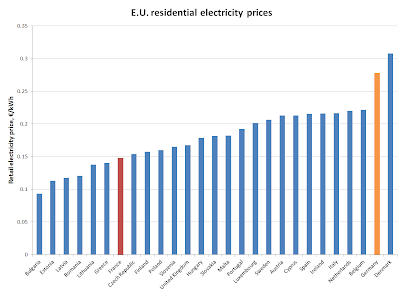
This image looks at EU countries by residential costs of electricity. It can be seen that nations which depend upon big wind and big solar — such as Germany and Denmark — pay a high price for power. And their costs are just beginning to build, as they double down on stupid.
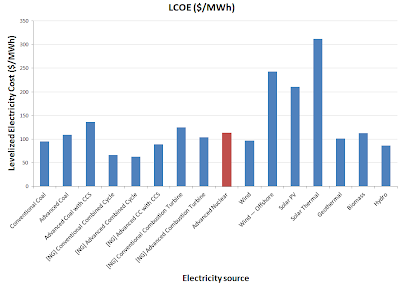
The above image looks at levelised costs for producing electricity by source. Solar and offshore wind score particularly badly by this metric. But regular onshore wind would score almost as badly if the costs of intermittency were included in overall costs. That is one of many deficiencies in the “levelised cost” metric, failing to account for all the costs of intermittency — which over the long run is the largest cost of big wind power besides the short lifespan of the powerplant.
Cost effectiveness of nuclear power for surface ships
The above study looks at US navy ships, but the cost comparisons should hold across the board for all long voyage, ocean going vessels.
More: Japan restarts Ohi reactor No. 3
Despite irrational green-fueled public protest, Japan carried through with the re-start of one nuclear reactor over the weekend. This should be only the first of many re-starts, as it is uneconomical to allow expensive power plants to sit unused in the midst of a power shortage. Particularly when the cost of nuclear fuel is extremely low in comparison to other forms of fuel.
Japan’s political challenge of re-starting its nuclear facilities points out the global challenge of combating lefty-Luddite dieoff.orgiast anti-nuclear greens — whether in Japan, Germany, Australia, the UK, or the US. Greens are leading Germany down a treacherous slope which will result in energy catastrophe unless a wiser leadership steps in.
Devising a wise energy strategy is difficult, due to the many factors involved, and the various approaches to comparing different methods of power production.
You must look at capital costs (or overnight costs), as well as costs of operation and maintenance, along with costs of replacement or decommissioning. But what is almost never included in the calculations — at least for intermittent unreliable sources such as big wind and big solar — are the costs of intermittency that must by absorbed by the grid and by grid customers.
Below is a table from the US EIA using data from 2010, comparing a wide range of power plant capital costs along with operating and maintenance (O&M) costs:
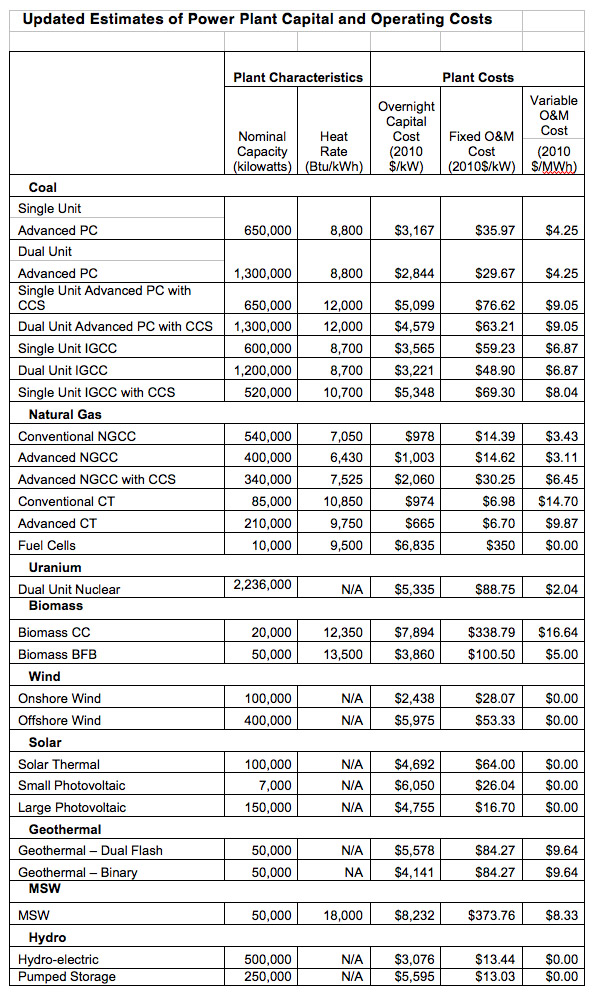
Notice that O & M costs for wind and solar are listed as $0.00 — quite a joke! When the true costs of O&M and intermittency are included with the nominal costs of wind and solar, the true nature of the boondoggle quickly becomes apparent.
The same criticism should always be applied to “levelised” costs of power production, such as the third graphic from the top, above. If the costs of intermittency and O&M are not included in the calculations — along with the capital costs and costs of insurance, financing, legal fees, likely changes in fuel costs, decommissioning, etc. etc., it is difficult to plan energy strategies over a multi-decadal time span.
If everyone follows the irrational, knee-jerk route taken by Germany and perhaps Japan — which is the path preferred by the US Obama administration — the western world is in for some very serious trouble in the not-so-distant future.
4 Comments on "Comparing Costs of Energy Production"
DC on Tue, 3rd Jul 2012 1:18 am
This Al fin moron again. Note that the figures he puts out do not include the trillions of dollars of subsidies lavished on the Fossil fuel cartel. Nor do they include an accurate account of the immense costs of shutting down NPP.
/Q Nuclear is second lowest with 3.5 cents, largely because of low fuel costs and the 60-year life expectancy of nuclear reactors.
Seriously Fin? I guess when you pretend those costs simply dont exist, then they just dissapear down the rabbit hole for good right?. Rest of this article can also be ingnored. But evil wicked solar supposedly, has the highest life-cycle costs, while nukes , get off 2nd best! Yea lot of credible data here.
Like, damn lies, and fossil-fuel shills.
BillT on Tue, 3rd Jul 2012 1:29 am
And then there is all of the nuclear waste that needs maintained for, oh, a thousand years. And the destruction of the atmosphere that is caused by the carbon sources, which has a cost to life in health AND dollars. Then there is the silting up of rivers from hydro, not to mention the disruption of life cycles of fish and the flooding of farm land.
Solar and wind probably disrupt the ecology the least, but require the other sources to exist. Oh well, we will be back to having none of them by 2100. There is more than dollars/euros to add in when you compute cost…
deedl on Tue, 3rd Jul 2012 8:23 am
The calculation for nuclear has two major drawbacks. First the cost for storing nuclear waste for millenia is certainly not incorporated, because nobody knows what amount of costs will accumulate during the next thousands of years. Second the cost of insuring the nuclear plants for nuclear disaster is not incorporated, because the insurance is the taxpayer, sinco no insurance comapany in the world did ever insure a nuclear power plant. Because no insurance company can estimate the costs and probabilities of nuclear distasters. By the way, when Great Britain privatized their energy sector, nobody wanted to buy the nuclear plants, because nuclear plants can not be run economically without heavy hidden subsisies and government insurance.
The calculation for cola also has two major drawbacks. The first one is to calculate with current coal prices, when a significant rise in coal prices can be expected the next years (http://www.renewableenergyworld.com/rea/news/article/2012/06/cheap-coal-is-dead-long-live-renewable-age-part-1?cmpid=rss). The second failue of the calculation is the incorporation of externalities into the cost. Externalities are costs caused by cola, but not payed for by coal, such as healthcare costs.
Finally when looking at electricity prices in germany, the whole story has to be told. It is true that prices are high and that renewables contribute to that. But it is also true, that abundand solar drives down spot price for electricity significantly and that the companies earn billions with the differences of spot price and price paid by the consumer. As long as the financial gain of the utilities is several times higher than the subsisied for renewables, which is still the case, the high energy prices in germany are to a big part caused by a utility oligopoly, which is scared to death by people producing their own electricity from wind and sun.
William T Dillings on Wed, 4th Jul 2012 12:12 am
After this prolonged power outage in the midwest and mid Atlantic, I don’t think utility consumers are worried about anything except getting reliable power without blackouts and brownouts, and without driving them bankrupt.
They don’t give a f**k about the niceties. All of us here believe in peak oil as much as the next guy, but this green energy BS and smart grid BS is gonna go over like a lead balloon with your average consumer, when they see the bill, and when they learn that their air conditioners and everything else can be shut down anytime somebody in central control feels like it.