
Peak Oil is You

Donate Bitcoins ;-) or Paypal :-)


Page added on June 3, 2012

Tech Talk – The Potential for Saudi EOR
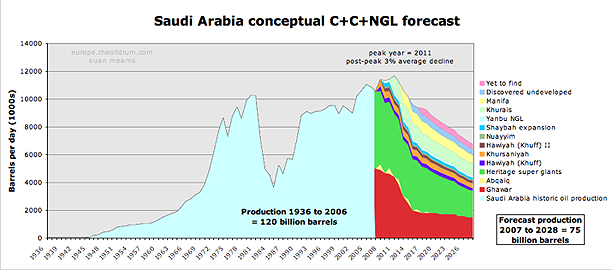
Without getting into the discussion of the other aspects of the site, it was interesting to read a post dealing with future oil production on “Watts Up with That” today, in which it is suggested that the forthcoming fall in Saudi oil production will presage the decline in overall global oil production. (The site has won the “Best Science” weblog award the past two years).
The relevant quote is
The next big one to tip over into decline will be Saudi Arabia.
And, if you have been following this series, then you will understand the basis on which I make the observation that this is, in fact, incorrect. The site uses a plot by Euan (without the link) from back in 2007, though it is credited to 2008.
There are a number of different examples to illustrate this, as I have documented earlier. In addition the KSA seems increasingly interested in developing the enhanced oil recovery (EOR) techniques that have helped other fields in the latter stages of their lives.
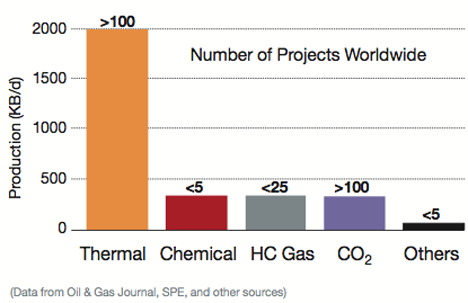
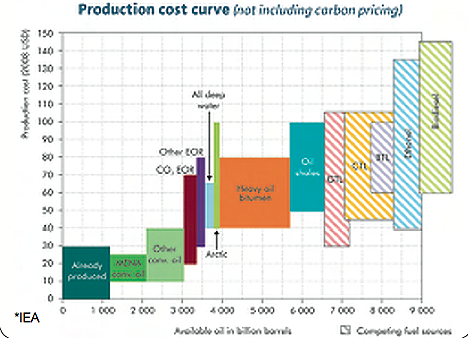

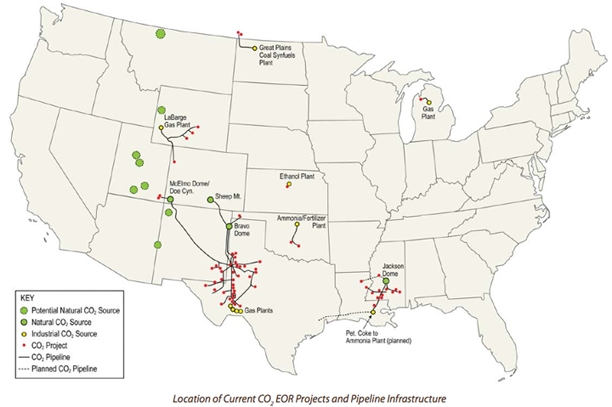
In WAG injection, water/CO2 injection ratios have ranged from 0.5 to 4.0 volumes of water per volume of CO2 at reservoir conditions. The sizes of the alternate slugs range from 0.1 percent to 2 percent of the reservoir pore volume. Cumulative injected CO2 volumes vary, but typically range between 15 and 30 percent of the hydrocarbon pore volume of the reservoir. Historically, the focus in CO2 enhanced oil recovery is to minimize the amount of CO2 that must be injected per incremental barrel of oil recovered, especially since CO2 injection is expensive. However, if carbon sequestration becomes a driver for CO2 EOR projects, the economics may begin to favor injecting larger volumes of CO2 per barrel of oil recovered, i.e., if the cost of the CO2 is low enough.
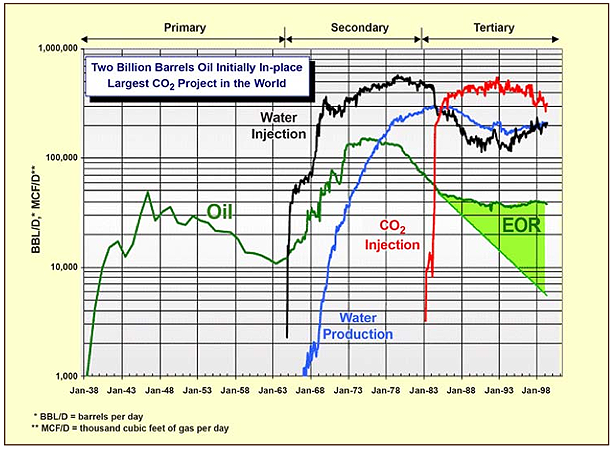
And how effective can it be? Consider this plot of production gains in the Wasson field in West Texas.
In regard to the SmartWater flooding the first field injections have been successful, and a full scale demonstration is now planned. The advantages for this change are considered to be:
• It can achieve higher ultimate oil recovery with minimal investment in current operations (this assumes that a water- flooding infrastructure is already in place). The advantage lies in avoiding extensive capital investment associated with conventional EOR methods, such as expenditure on new infrastructure and plants needed for injectants, new injection facilities, production and monitoring wells, changes in tubing and casing, for example:
• It can be applied during the early life cycle of the reservoir, unlike EOR.
• The payback is faster, even with small incremental oil recovery.
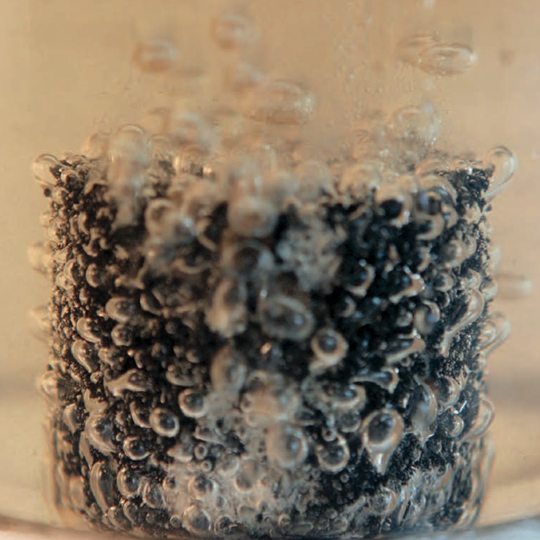
A BP study (Lager, A., Webb, K.J. and Black, J.J.: “Impact of Brine Chemistry on Oil Recovery,” Paper A24, presented at the EAGE IOR Symposium, Cairo, Egypt, April 22-24, 2007. Also Strand, S., Austad, T., Puntervold, T., Høgnesen, E.J., Olsen. M. and Barstad, S.M.: “Smart Water for Oil Recovery from Fractured Limestone: A Preliminary Study,”) showed the following incremental gains over conventional water flooding.

When these current projects, in their various stages, are combined with the future production from Manifa, and enhanced production from Safaniyah, I expect that the Kingdom will continue to produce at around 10 mbd for at least a few years more, though I continue to doubt that it will be able to increase much beyond that. After all, even when field declines are held to 2% a year, after 50 years the arithmetic starts to take an increasing toll – Ghawar began production in 1951.
And so, with respect, I disagree with David Archibald, if only in the short term – but for those of you with a few minutes, the comments that follow his post at WUWT are quite entertaining.
One Comment on "Tech Talk – The Potential for Saudi EOR"
BillT on Mon, 4th Jun 2012 12:47 am
No matter how you slice it, we are in permanent decline…