
Peak Oil is You

Donate Bitcoins ;-) or Paypal :-)


Page added on May 27, 2012

Conditions and Treatments in North Ghawar
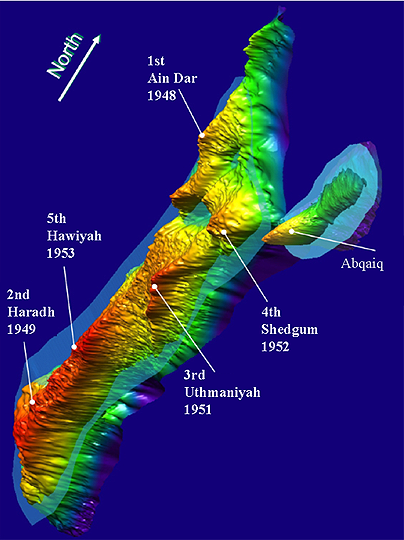
Recent OGPSS talks have focused on the increased use of novel technology in Saudi Arabia, as a means of recovering stranded oil, left during the waterfloods that have successfully sustained production over the past few decades. That technology is being further expanded with the use of carbon dioxide injection as part of an Enhanced Oil Recovery program. The CO2 project has been in the works for some years with an initial estimate that some 40 million cubic feet of CO2 would be injected daily into flooded areas of the Ghawar field. The gas will come from the Uthmaniyah Injection Plant and will be initially injected into seven wells in the Uthmaniyah section of Ghawar. The initial flood will be monitored, since it is important to ensure that the CO2 finds the oil that it will help flow to production wells.
Aramco have also recently announced success with changing the make-up of the injection water being pumped into the fields to sustain pressure. By altering the ionic composition and salinity of this water it has been possible to significantly increase the amount of oil that is liberated and thus recovered from the reservoirs.
Ghawar is sufficiently large that it has been divided into different segments, and the conditions vary between them. Because of the differences between the various regions, the overall statement that Ghawar is producing some 5 mbd has to be read with a degree of caution, lest it be presumed that this has continued to be from the same regions of the overall field. (And while this article deals with oil production, it should be noted that Ghawar also produces around 2.5 billion cubic feet (bcf) of natural gas a day.)
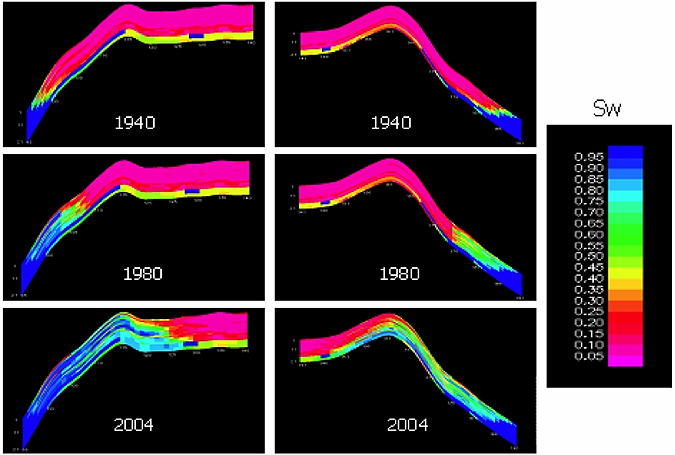
Stuart Staniford and Euan Mearns have, among others at The Oil Drum, provided extensive sets of information on Ghawar over the years. For those that are not familiar with the region, Stuart’s early description is a good place to start. In this brief overview I will not get into any of the details of those descriptions, though I will quote one or two of the most relevant highlights. The debate initially focused on the amount of the waterflood in different regions of the field, since it was possible, with extensive work, to extract information on the rate that the water was advancing, relative to the remaining volumes in the different regions. For example, in one of his earlier posts, Stuart showed the following sequence of profiles for the water progression across a section of the field at Uthmaniyah. This was followed by an additional response from Euan.
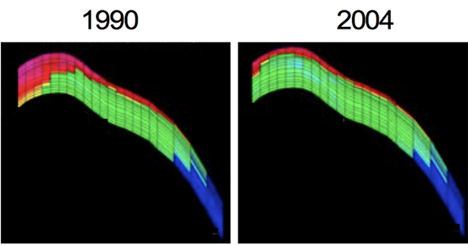
*90% or so of ‘Ain Dar/Shedgum’s 2mbpd could water out over the course of a few years.
*We are likely somewhere in the midst of that process.
*That is likely the explanation for most of the Saudi production declines we have seen since June 2005 (including the failure of Haradh III and Qatif/Abu Safah to raise production).
The discussion at the time (which is still present in comments under the main papers) was fascinating, since it was based, inter alia, on information such as the speed at which the water front was advancing.
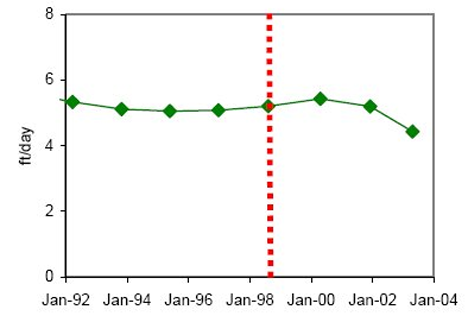
What these new technologies bring with them is the ability to go back into the older regions of Ghawar and extract some of the oil that was left in place during the original water floods. Because a number of them will be dealing with regions of the reservoir that are already flooded, so that the oil will be coming from wells with a high water cut, it is in my opinion unlikely that these will allow increases in production from the region, but rather that it will allow a sustaining of existing production levels somewhat further into the future than we (the collective wisdom of the TOD writers) have predicted in the past.
But Ghawar is not just the original wells of the North, and I will have more to say about the field, and then about other fields in the country in future posts.
7 Comments on "Conditions and Treatments in North Ghawar"
Beery on Sun, 27th May 2012 4:08 pm
Why does the image of the Ghawar oil field look suspiciously like the map of New Zealand? Coincidence? I think NOT!
DC on Sun, 27th May 2012 4:47 pm
First thing I thought too! I thought, hey are they trying to frak NZ now?!
🙂
TOD is no longer a good resource for Oil depletion trends. I used to read its articles and conversations all the time. Now I just skip them. ToD seems more interested in cheerleading for the oil status-quo than discussing PO and its effects.
Am I only one that thinks TOD has changed?, and not for the better?
John Orr on Sun, 27th May 2012 8:03 pm
What happens to the space when all that oil comes out??? If u equate that to oil tankers, say one a day for London, anyone know how days left??? So calculating this out have we taken out more oil tankers than the well area dictates …. does this mean that the oil field replenishes it’s self???
MrEnergyCzar on Mon, 28th May 2012 1:36 am
Hasn’t Canterell in Mexico been on nitrogen life support for a few years and has collapsed production now….
MrEnergyCzar
BillT on Mon, 28th May 2012 3:18 am
They are no longer scraping the bottom, now they are under the barrel … squeezing the sand. With domestic consumption growing at 7% per year and an obvious peak in production, how long before they do not export ANY oil? 10 years? Sooner? Then what, Empire?
John Orr on Mon, 28th May 2012 9:41 am
Anyone ever seen or have access to a global high tech image, like the Ghawar field, showing the worlds oil fields and any areas that look to be positive, Artic etc… and have been untapped???
Duke on Mon, 28th May 2012 2:51 pm
No Worries! I heard they just found three new Ghawar sized fields under Wall Street. Too bad it’s all snake oil!