
Peak Oil is You

Donate Bitcoins ;-) or Paypal :-)


Page added on May 9, 2012

The IMF and Hubbert
The IMF just published a working paper with an eye-catching title The Future of Oil: Geology versus Technology. To my knowledge, this is is the first time a peak oil scenario, in the form of a Hubbert Linearization, is explicitly injected into a econometric model. Based on the work of Hubbert, Deffeyes and Campbell, available supply is modeled by a Hubbert curve plus a marginal supply component sensitive to prices.
The Hubbert Linearization is a way to plot the annual production as a fraction of a cumulative production versus the cumulative production. If production follows a Logistic curve (aka Hubbert curve) then a linear relation can be observed
\[\frac{q_t}{Q_t}= \alpha_s − \beta Q_t\]
where \(\alpha_s\) and \(\beta=\alpha_s/URR\) are related to the logistic growth rate and the Ultimate Recoverable Resource respectively. Figure 4 from the IMF paper shows the result of the Hubbert linearization following Deffeyes 2005 projection with an URR at 2.013 Trillion barrels.
 |
| Figure 1. Oil Production Forecasts in the Deffeyes (2005) Model (Q in gigabarrels, q in gigabarrels p.a.). src: IMF, Figure 4. |
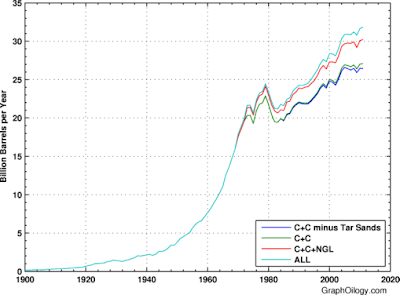
The IMF correctly observes that total supply has been diverging from a straight line since 2004. There is some confusion on what definition exactly they are using for World supply. This is tricky of course because only conventional oil could possibly follow a geological peak whereas biofuels and NGL would follow different constraints. The IMF quotes the work of Deffeyes, however, Deffeyes was originally only looking at conventional crude oil. On the other side of the equation, demand is met by the total volume of liquid fuel available regardless of its origin. It is said that the model results are based on the IEA data for crude oil, condensates plus Natural Gas Liquids (NGL). It is a little bit strange because the IEA is publishing an estimate for World supply only for All liquids at least in the Oil Market Reports. Total supply usually includes Natural Gas Liquids, syncrude from tar sands, heavy oil such as raw bitumen, biofuels, refinery processing gains, etc.. The EIA database is giving 86.94 Mb/d for 2011 or 31.73 Giga barrels (see Figure 2 below). Considering only crude oil, condensates and NGL, we get 30.13 Gb/d for 2011. Looking at their forecast (Figure 10 page 30), the 2011 data point is clearly above 31 Gb so it seems to indicate they are considering All liquids.
 |
| Figure 2. World Production (C+C= crude oil and lease condensates) |
Since 2004, it is clear that supply growth is coming from unconventional sources and NGL while conventional oil production is basically flat.
 |
| Figure 3. Supply growth per category (100= Jan 2001). |
Looking at the residuals between the Hubbert Linearization and supply on Figure 1, there is a correlation between residuals with real prices.

It then follows that the deviation from the Hubbert line is interpreted as an increase in marginal supply due to high prices
$$\frac{q_t}{Q_t}= \alpha_s − \beta_1 Q_t+\beta_2 p_t +\beta_3 \frac{1}{3}\sum_{k=4}^6 p_{t-k}$$
more to come.
5 Comments on "The IMF and Hubbert"
SOS on Wed, 9th May 2012 12:36 pm
Lol.
BillT on Wed, 9th May 2012 2:35 pm
All Liquids = oil, moonshine, rubbing alcohol, vodka, rum, cooking oil, scotch, etc.
Got to keep those fake numbers growing or the sheeple will panic and stop buying those SUVs.
Ham on Wed, 9th May 2012 6:46 pm
Mumbo-Jumbo. EROEI is way more important. If Ghawar now needs CO2 injection because it is in the throes of sulphurous increase and dying, what difference is a math equation going to make?
BillT on Thu, 10th May 2012 12:59 am
This article is to wow the ignorant with scientific mumbo jumbo. The pretty graphs all point up so that is what they will think, that fuel sources are going up, not down. EROEI is all you need to know about energy.
Sinnycool on Thu, 10th May 2012 11:40 am
Even if it was all true and correct it deals only with geology.
No hint of factors like
– ELM (Export Land Model)
– or the inability to maintain production as the rising cost of production exceeds the reduced sell price caused by demand destruction
– or the inability of the West to fund the speculative development of new fields owing to financial collapse and instability…