
Peak Oil is You

Donate Bitcoins ;-) or Paypal :-)


Page added on February 8, 2012

Businessweek Gets it Wrong – Everything You Know About Peak Oil is ‘Not’ Wrong
On January 26, Bloomberg Businessweek printed an editorial by Charles Kenny titled, “Everything You Know About Peak Oil Is Wrong”. This editorial reflects several common misunderstandings.
According to Kenny:
Titled Limits to Growth, their report suggested the world was heading toward economic collapse as it exhausted the natural resources, such as oil and copper, required for economic production. The report forecast that the world would run out of new gold in 2001 and petroleum by 2022, at the latest.
Limits to Growth gives a table that might be interpreted to show that oil and gold new extraction will be exhausted by the dates indicated. The book is careful to explain that the situation is more complicated, though. The way the book summarizes the issue is as a price problem:
Given present resource consumption rates and the projected increase in these rates, the great majority of non-renewable resources will be extremely costly 100 years from now.
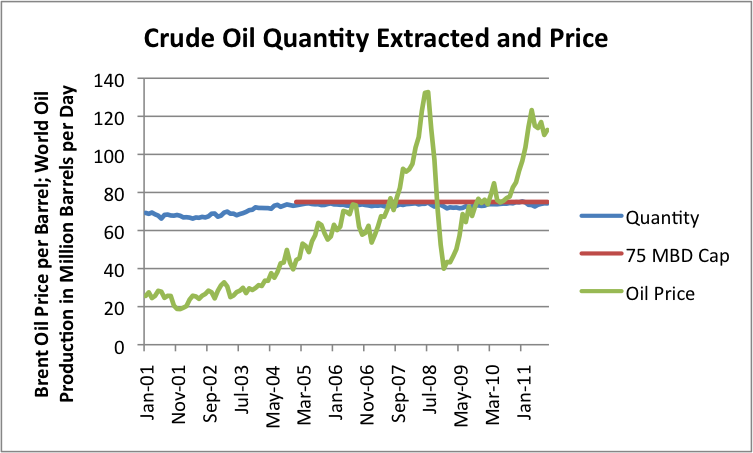
In fact, high cost is precisely the issue with oil right now, and we are still ten years away from 2022. A graph of recent crude oil production is shown below. The amount of production has not been able to rise above about 75 million barrels a day (MBD) since 2005. At the same time, price is very high.
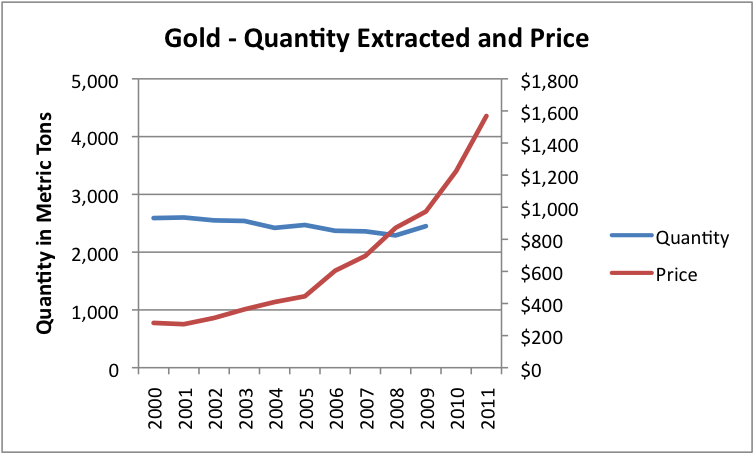
If we look at gold production and prices, it shows pretty much the same story: stalled out production and very high prices.
The problem is a two-fold problem: it is a price problem, and a problem of not being to increase extraction as much as one would like. The issue is one of declining quality of resources, as lower grade ores are found, and more difficult to extract oil is found. There are plenty of resources available; the issue is that we cannot afford the high cost of extracting them.
Kenny says, “Far from being depleted, worldwide reserves of minerals continue to climb.” He then goes on to list a whole host of resources: natural gas liquids of 1.2 trillion barrels, shale oil of 4.8 trillion barrels, and tar sands of 6 trillion barrels.
These are lower and lower quality resources. In order to make sense for these resources to be extracted, it is important that the cost of extraction not be too high. Many of the large oil importing nations went into recession in 2008-2009 when oil prices climbed to $147 barrel, and quite a few economies are struggling now, with prices in the $100 to $110 barrel range. Unless we can get the oil out at a reasonable price, there is no point in even counting them in the base.
There is also an issue of how quickly resources can be extracted. Canada has been attempting to develop the oil sands since 1967, but even after more than 40 years of attempted development, only 2% of the world’s oil supply is from this source.
Kenny also doesn’t seem to understand that Daniel Yergin is far from an unbiased observer. He says,
And yet according to renowned oil analyst Daniel Yergen [sic], technology advances and new discoveries have allowed oil reserves worldwide to keep growing.
Daniel Yergin is chairman of IHS Cambridge Energy Research Associates and Executive Vice President of IHS. The companies he works for do consulting work for oil companies. These oil companies would like you to think that their prospects for the future are as good as possible. In many ways, Daniel Yergin’s role is not too different from that of Jack Gerard, CEO of the American Petroleum Institute. If a person checks back, one finds that many of Yergin’s rosy predictions have proven false.
Kenny has another overstatement:
New technologies suggest the dawn of U.S. energy independence.
This is flowery language, but doesn’t represent the real situation. A big part of the reason our imports are down in recent years is because US oil consumption is down. People who are laid off from work drive less, and with high oil prices, fewer people take driving vacations or go by airplane. The EIA shows this graph of net imports.
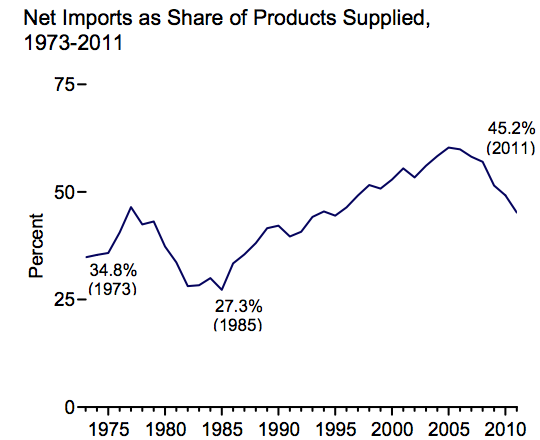
We are still importing 45.2% of “products supplied”. This comparison is on a volume basis, not on an energy basis. If the comparison were on an energy basis, we would be importing over 50% of petroleum products. Biofuels and natural gas liquids, which are lower energy than oil, are treated if they were substituting for oil on a barrel for barrel basis, but they really are not.
We hear a lot about having very low natural gas prices right now, because of higher production of natural gas combined with a warm winter. Unfortunately, having more natural gas doesn’t fix our oil problem. Our oil problem is the fact that price is too high because of inadequate world supply and also because much of the cheap-to-extract oil is already gone. We have had to move on to more expensive-to-extract oil supplies.
Over time, natural gas may make a small dent in our oil problem, if a few vehicles can be converted to natural gas. But the large size of natural gas tanks and lack of refueling stations make them unsuitable for many uses. The amount of natural gas available for substitution also isn’t all that high, relative to the world oil deficit.
Kenny also said:
Limits to Growth suggested the world would be on the verge of complete economic collapse around about now, with industrial output falling to its level of 1900 by the end of this century, as resources vital to sustaining a modern economy dried up. However dire today’s global financial crisis, we are nowhere near such a doomsday scenario.
I would disagree with Kenny on this. He doesn’t seem to see the close connection between high oil prices and the economic problems we are seeing today. With high oil prices, people cut back on discretionary goods, resulting in layoffs among people who work in those industries. For example, fewer people have jobs in vacation industries (for example, in Greece and Spain) if oil prices are high. This leads to recession and debt defaults. If one country defaults, ripple effects can spread to banks around the world.
Our economy has a high level of debt. We need economic growth in order to repay that debt with interest. If oil supply remains flat, or worse yet, falls, it will be difficult to produce the level of economic growth needed to prevent debt defaults.
Hopefully, Kenny will be right about the issue of economic collapse, but it seems to me that the possibility should be a serious concern. Peak oil and the related issue of Limits to Growth are real issues, even if Charles Kenny doesn’t understand them.
9 Comments on "Businessweek Gets it Wrong – Everything You Know About Peak Oil is ‘Not’ Wrong"
BillT on Wed, 8th Feb 2012 2:27 am
Obviously, he (Kenny)doesn’t understand or refuses to. It is likely that there will still be billions of barrels of accessible oil left in the ground because, it appears that the financial system to support it’s extraction and use is going to implode soon. Perhaps the Age of Petroleum will not end, but just go away because we cannot afford it any more.
I like the part of Ayn Rand’s book “Atlas Shrugged” where the small oil producers cheer to hear that the biggest oil producer just went out of business. Then a few months later, they find out that the drills for their wells no longer cost $50 each but more than $500 because there is no demand for them and they are more expensive to make in small numbers. This puts the small oil producers out of business also as they cannot afford the high prices for parts and equipment.
Bernz223 on Wed, 8th Feb 2012 3:21 am
Yeah and you BillT are such an “expert” on oil. Do you worship Mike Ruppert as your god too?
Joseph on Wed, 8th Feb 2012 4:04 am
Who’s to say BillT is not Mike? He seems to live here, and have an opinion about everything. Or rather enjoys talking into the echo chamber of the comments section.
Anvil on Wed, 8th Feb 2012 5:17 am
Anything is better than sucking the cock of MSM.
BillT on Wed, 8th Feb 2012 6:10 am
Bernz…I know what ‘reality’ is. Do you? The price of a product is determined by production efficiency as well as materials costs. If Apple sells only 10 PCs per year instead of 100,000, those 10 are going to be multiples of costs higher to make and the sales costs will be also multiples higher.
Whether you can buy gas at the local station is more than how much oil is left in the world and more the end result of thousands of interim activities that gets it from 4 miles under the ocean to your gas tank. Much of that process requires a very complicated financial system that is slowly crumbling.
The physical process starts not at the well, but at the mines. Those oil rigs are many thousands of tons of steel that are mined by digging out many millions of tons of ores that then have to be hauled, refined, hauled, smelted, hauled, machined, and hauled again to the construction site where they are assembled and once more hauled to the site and anchored to the sea bed. THEN the drilling begins, using intricate drill heads, shafts and piping to reach the oil miles below.
ALL of this is required before the first drop of oil comes up to be transported to the refinery, then piped or hauled to the local storage tanks and then hauled to your local gas station. It is a very financially dependent system that is only going to exist until one part of it collapses. And, at this point, it seems like the part to collapse will be the financial underpinnings.
kervennic on Wed, 8th Feb 2012 1:12 pm
I agree with the core of the article, off course, but the price of gold is a bad example, at least not such a good one.
It is clear that gold price has not collapsed and will not collapse because gold has proven so difficult to find and is now very dilute in remaining mines. But the sharp ongoing rise, that is according to me only a very mild beginning, is not similar to the rise of other commodities which are mostly priced according to demand for actual use.
Gold is, because of its physical nature (rare and stable), the ultimate form of money, and its rise is a more direct reflection of the monetary problem, where states who have no control of money,debts and banks have lost credit.
The monetary mass is huge and loses ground as productive capital, thus the decreasing value of dollar and the increase in gold price.
However, if we look at basic commodities like energy, transportation and food, all these things that cannot be made cheap by putting pressure on the labour force and mechanization, the price are now skyrocketting. My buss-tram pass went up 10 % this year in sweden as well as most of my food, not talking about rent. All this is the core of my conssumption pattern. Governement off course talk about 2% “inflation”, but for low classes, it is more than that.
This is why a high inflation on “hardcore” commodities (which will rebound on other price later on) and a huge monetary mass (ie a stach of promise) is only is the fundation for a future spiraling distrust for paper money.
I think most fortunate people have their finger on the “buy gold” button and wait for their neighbors to push hard on it.
It is probably hight time that other much less fortunate people start to have the same understanding of the real value of paper money: in an economy based on a decreasing ressource, it’s future value will rapidly zero, in a matter of years and not decades.
BillT on Wed, 8th Feb 2012 3:54 pm
Kerv…you are correct. If you cannot afford gold, silver will be the poor man’s gold as it too is becoming more and more scarce and is also used in so many industrial products that the demand will be there for a long time. Gold, and to a lesser extent, silver have been the money used in trade for millennia. That will not change when the Euro and the dollar become small sheets of toilet paper.
BillT on Thu, 9th Feb 2012 1:19 am
Joeseph, am not anyone but myself. I like commenting and disabusing so many who think they can keep living the same life style forever. That is why they put a comment section on this site. It is amazing how dumbed down American’s are today. The best and most intelligent comments are usually from foreigners or Americans living over seas where reality is still in the news.
BTW: I am retired so I have a lot of time to keep up with events and developments in science. I also have seen Europe, the Middle East, and am now exploring Asia as I live in the Philippines. Being 67, I have seen a lot of ‘history’ first hand and can see how the Us has fallen.
Dominik on Tue, 21st Feb 2012 1:27 am
the predisent is stuck between a rock and a hard place if we don,t do something about fossil fuels changing the weather who will dogs cats or monkeys yes it,s got to be all of us your just to do the same-thing you are accusing our predisent of and thats dividing the nation we,ll be divided on this issue until actual dooms day no matter who the predisent is