
Peak Oil is You

Donate Bitcoins ;-) or Paypal :-)


Page added on January 28, 2012

Another Terrifying Drought Paper

The conviction has been growing in me for quite some time that the really big deal about global warming is increasing frequency and severity of droughts. If I’ve succeeded in convincing you of this too (or you already believed it for other reasons of your own), then you will be interested in a new paper by Wehner et al (a group of scientists at NOAA and US national labs) titled Projections of Future Drought in the Continental United States and Mexico. The full paper doesn’t seem to be freely available on the Internet but there’s a press release and also conference talk slides that will give you the flavor. Furthermore, a reader sent me a copy and I’ll summarize the points that interested me here.
Let me start by explaining the figure above which is really the heart of the paper. The x-axis of the figure is time during the twentieth and twenty-first century. The y-axis plots the fraction of the area of the US and Mexico that is in at least moderate drought (PDSI less than -2). The red and black lines are based on two different estimates of the historical PDSI: both use the same code for generating the PDSI that NOAA uses for its regular drought monitoring but they use temperature/precipitation data series from different groups as the input to the PDSI calculation. Then the pale grey lines represent the (corrected) PDSI from nineteen climate model runs used in the IPCC AR4 process with the A1B emissions scenario (the world is currently tracking noticeably above this scenario). The purple line is then the average of the 19 model runs (ie all the grey lines which are too blurred together to really see well). Because the purple line is an average of 19 simulated worlds, it has much less fluctuations in than the one real world (red/black lines). Also, because climate models seem to systematically under-estimate drought in the twentieth century, the purple line is below the red line on average.
But here’s the kicker: notwithstanding the fact that the models seriously underestimate the level of drought in the 20th century, by the end of the 21st century, their average has reached around a level a little above 0.6. And if you look over to about the mid 1930s you’ll see a red spike – the worst year of the dust bowl – which extends to about 0.65 (hard to see the exact level in the figure above but you can see it clearly in the version in the slides). So the paper is saying that climate models predict a level of US/Mexican drought in 2100 that is comparable to the worst year of the dustbowl. As the press release puts it:
These models showed that the normal state for much of the continental United States and Mexico in the mid- to late-21st century would be conditions considered severe to extreme drought by today’s standards.
Holy shit.
One interesting thing is that this new paper does not cite, and shows no awareness of, the line of papers by Dai and coauthors that I have covered extensively on this blog. While that’s a flaw in the paper, it does mean that the broad conclusions of those papers have been reproduced completely independently by a different group of scientists.
Needless to say the conclusions here are terrible – if there is that much drought on a regular basis, lots of US forests will be turning into savannah (and savannahs into grasslands or deserts) and there will be huge releases of carbon dioxide from the biosphere – really nasty positive feedbacks that the climate models I’m quite sure are not capturing properly – and we are really going to turn our beautiful planet into a hell fit only for robots to live on.
If you want to see the best guesses as to the regional distribution of the problem, here they are:
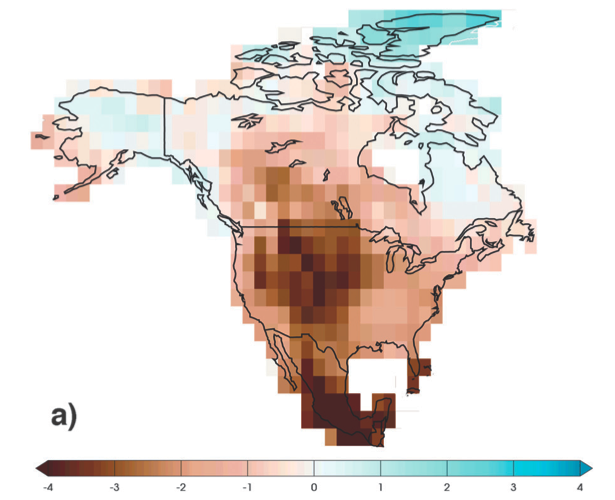
This shows the change in the average PDSI in the models regionally. Note the scale – the dark brown is a full -4 shift: the new normal will be extreme drought by the standards of the past. So if this map is right, you can basically kiss Mexico goodbye altogether and the mountain west and great plains look terrible too. However, I wouldn’t necessarily see the map as very certain for reasons I’ll discuss in a moment.
Is there any escape from this conclusion?
Well, the one hope is that it turns out that the climate models really suck at reproducing the historical conditions of drought. This isn’t as much comfort as it might be since it turns out they really want to under-predict the amount of drought, but such hope as there might be, it lies in there. In particular, when the authors first ran the PDSI calculation on the model temperature/precipitation variables, the models really grossly failed to explain the 20th century level of drought: it’s the left picture in this pair:
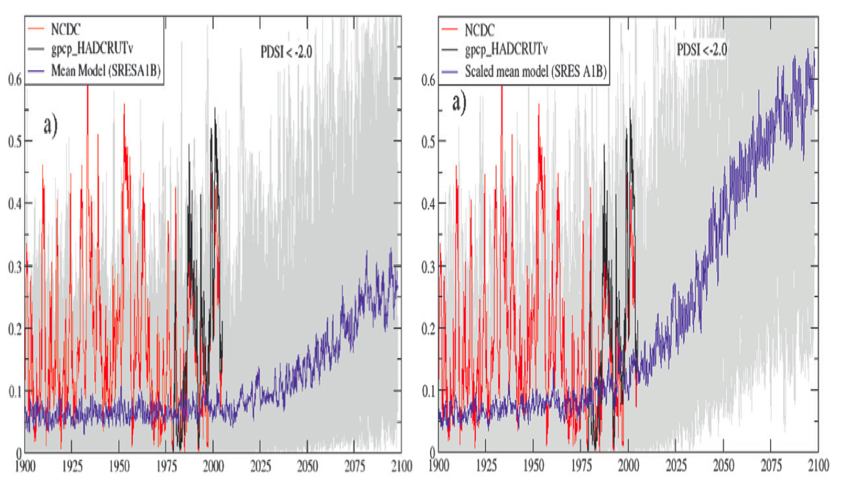
The first thing the researchers noticed is that the models have a tendency to predict too much rain and not enough heat in some parts of the country. So they took the temperature and precipitation for each model, and for each simulation grid cell, and rescaled them so that the average over the twentieth century matched the actual average in the real world. Then they reran the PDSI calculations and that’s the picture on the right (which is also the one at the top of the post). You can see that this adjustment hasn’t really solved the problem in the twentieth century – though it’s a bit better – but the prediction in the twenty-first century is pretty sensitive to this adjustment.
Presumably, the real problem is that the climate models aren’t very good at producing the kind of long hot rainless summer that gives rise to killer droughts (like in Texas in 2011). The rainfall and temperature in the model probably lack sufficiently long auto-correlations to produce real world droughts. Still, just adjusting the model output to have the correct mean values before doing the PDSI doesn’t seem like a crazy thing to do: although it’s crude, it’s hard to argue that it invalidates the right hand side figure. Still, the fact that the models clearly fail to capture the most important dynamics of drought should give one some pause.
Pretty much all the models predict more drought – that’s a robust prediction that arises because the increasing temperature produces more moisture demand on the soil than the precipitation can supply, even where the latter is increasing. However, one story you might try to tell about how it might not be so bad: suppose climate change makes the weather less correlated (ie more changeable) so now it becomes very unlikely to have an entire hot summer, but instead you get a hot week or three and then a bunch of rain and cooler weather and then back again. That might produce less drought even in a warmer world, but climate models simply couldn’t credibly predict this trend (or the reverse) since they do a rotten job of predicting the level of drought now.
Of course, there isn’t the slightest reason at the moment to suppose the weather is going to get more changeable under anthropogenic climate change – it’s just a place where you could park some doubt, if you really didn’t want to believe this stuff. Right now, it looks a lot more likely that we really are headed into a future with a lot of killer droughts.
More research desperately needed. And more action on climate change from individuals and politicians too. Please.
7 Comments on "Another Terrifying Drought Paper"
Harquebus on Sat, 28th Jan 2012 2:40 am
Plant lots and lots of trees.
Tomgood on Sat, 28th Jan 2012 10:45 am
Gee, you anthropogenic global warming alarmists really pee me off. First its increased rainfall weather events such as the Queensland floods which are the result of anthropogenic global warming, but then now its drought that is being caused by the same thing. Any time it rais now on my kids outdoor event, I’m being told its all the fault of global warming. Wake up and smell the coffee (myself, I prefer flowers) people, AGW is a MYTH! Peak oil, on the other hand, is something we are all going to have to deal with quite soon. Grrow up and deal with the real issue.
don norris on Sat, 28th Jan 2012 11:21 am
No Tomgood, your views are mythical. See, I can make bald statements without the burden of citations to substantiate my views too. 97% of climate scientists are wrong because Tomgood says so. Right.
BillT on Sat, 28th Jan 2012 12:24 pm
Ah, ignorance is bliss!
Did the article say that it would never rain?
Does it claim that there will not be wet areas in the world?
Did it claim that extreme storms will not happen?
No, it claims that excessive heat will change the climate in most areas to a MORE dry average. AVERAGE is the key word. But, rain at the wrong times is as bad or worse than no rain at all. If you get a storm that dumps 10 inches of rain in 10 hours…(I’ve seen that) and then it does not rain for weeks, it may average out to slightly dryer than normal, but crops don’t survive. And soil becomes dust and blows away.
BillT on Sat, 28th Jan 2012 12:28 pm
BTW Tom, I think water is going to be the major problem before oil is. Peak oil only means that it will get more and more expensive, but there will be oil for decades. Water, on the other hand, supports life and when the ground water is gone or polluted and is not drinkable or usable on crops, then water will have greater value than oil. You can live with out oil. You cannot live more than a few days without water.
MrBill on Sun, 29th Jan 2012 1:44 am
Isn’t one of the theories of global warming that some areas will see increased precipitation and other areas will see decreased precipitation?
BillT on Sun, 29th Jan 2012 3:05 am
MrBill, yes, at least you understand. Too many think that if it doesn’t happen to them, it is not happening.