
Peak Oil is You

Donate Bitcoins ;-) or Paypal :-)


Page added on January 23, 2012

Peak Oil’s Impact: Credit Cards
Other posts will describe routine aspects of daily living that will likely change when producers of goods and services no longer have inexpensive and adequate supplies of the fossil fuel resources they need. I’m certain that the questions I raise will in turn raise other concerns as well. It is only by acknowledging the consequences affecting each of us that we can begin an intelligent national process of planning and implementing new methods of providing the goods and services we’ll need or desire.]
~~~
I don’t know if this is good news or bad, but credit card usage was up in 2011. [1] We’ve all survived another holiday shopping season, and if we’re behaving reasonably, we’ve all decided to hide a credit card or two for a few more weeks as part of our recovery.
I’ll confess that they are handy (as are debit cards, although my wife and I use those only on rare occasions). We’ve pared down the amounts and frequency with which we use them nowadays, but for most of our everyday purchases (gas for the cars, groceries, dry-cleaners, etc) they remain the standard. They are also quite handy in setting up online accounts as well … no fuss, no bother. Just click and pay. Great to have for all that Christmas shopping!
Raw Materials
[Credit] cards are made of several layers of plastic laminated together. The core is commonly made from a plastic resin known as polyvinyl chloride acetate (PVCA). This resin is mixed with opacifying materials, dyes, and plasticizers to give it the proper appearance and consistency. This core material is laminated with thin layers of PVCA or clear plastic materials. These laminates will adhere to the core when applied with pressure and heat.
A variety of inks or dyes are also used for printing credit cards. These are available in a variety of colors and are designed for use on plastic substrates. Some manufacturers use special magnetic inks to print the magnetic stripe on the back of the card. The inks are made by dispersing metal oxide particles in the appropriate solvents. Additional special printing processes are involved for cards, like VISA, which feature holograms.
The Manufacturing Process
The manufacturing process consists of multiple steps: first the plastic core and laminate materials are compounded and cast into sheet form; then the core is the printed with appropriate information; next the laminates are applied to the core; and finally the assembled sheet is cut into individual cards.
Plastic compounding and molding
1 The plastic for the core sheet is made by melting and mixing polyvinyl chloride acetate with other additives. The blended components are transferred to an extrusion molding apparatus, which forces the molten plastic through a small flat orifice known as a die. As the sheet exits the die, it goes through a series of three rollers stacked on top of each other that pulls the sheet along. These rollers keep the sheet flat and maintain the proper thickness. The sheets may then pass through additional cooling units before being cut into separate sheets by saws, shears, or hot wires. The cut sheets enter a sheet stacker that stacks them into place and stores them for subsequent operations.
2 The laminate films used to coat the core stock are made by a similar extrusion process. These thinner films may be made with a slot cast die process in which a molten plastic film is spread on a casting roller. The roller determines the film’s thickness and width. Upon cooling the films are stored on rolls until ready for use.
Printing
3 The plastic core of the card is printed with text and graphics. This is done using a variety of common silk screen processes. In addition, one of the laminate films may also undergo subsequent operations where it is imprinted with magnetic ink. Alternately, the magnetic stripe may be added by a hot stamping method. The magnetic heads used to code and decode the iron oxide particles can only operate if the magnetic medium is close to the surface of the card, so the metal particles must be placed on top of the laminating layer. Upon completion of the printing process, the core is ready to be laminated.
Lamination
4 Lamination helps protect the finish of the card and increases its strength. In this process, sheets of core stock are fed through a system of rollers. Rolls of laminate stock are located above and below the core stock. These rolls feed the laminate into the vacuum shoes along with the core stock. The vacuum holds the three pieces of plastic together while they travel to a tacking station. At the tacking station a pair of quartz infrared heat lamps warm the upper and lower plastic films. These lamps are backed with reflectors to focus the radiant energy onto a narrow area of the films, which optimizes a smooth bonding of the film to the core stock. The laminate films are then fully bonded to the core stock by pressing with metal platens, which are heated to 266° F (130° C) and applied with a pressure of 166 psi/sq inch. This lamination process may take up to 3 minutes.
Die cutting and embossing
5 After lamination has been completed, the finished assembly is cut and completed by die cutting methods. Each assembly yields a sheet, which is cut into 63 credit cards. This is achieved by first cutting the assembly longitudinally to form seven elongated sections. Each of the seven sections is then cut and trimmed to form nine credit cards. In subsequent operations, the card is embossed with account numbers. The finished cards are then prepared for shipping, usually by attaching the card to a paper letter with adhesive. [2]
There were 1,488,000,000 credit cards in use 2006 and that number is projected to grow to 1,618,000,000 in 2010….
A stack of the 1.5 billion credit cards in use in the U.S. would reach more than 70 miles into space and be almost as tall as 13 Mount Everests….
There were 354 million debit cards in use 2006 and that number is projected to grow to 484 million in 2010. [3]
That is much more than I ever wanted or needed to know about credit card manufacturing, and I’m safe in assuming it’s more than you ever cared to know as well. The above information may be a bit dated, but I’m further assuming that the manufacturing processes remain essentially the same. The economy may have impacted the Census Bureau estimates in the second quote above, but it’s reasonable to assume that here in the U.S. there are still well over one billion credit and debit cards circulating in and out of wallets and purses today.
I couldn’t bring myself to determine the materials needed to obtain, manufacture, supply, transport, dispose of, or market each of the dozens of components required to create a credit card, and who knows how many hundreds of processes and components needed to obtain, manufacture, supply, transport, dispose of, or market each piece of machinery required to get from A to Z in the world of credit card manufacturing. How many workers and suppliers who depend on this industry is beyond my capacity to imagine.
A lot is a good guess. An even more accurate guess is that none of those dozens/hundreds of steps happen without some measure of fossil fuel at each and every one of those individual phases. Without twisting yourself into knots, just think about this entire A to Z process for another moment and consider that observation.
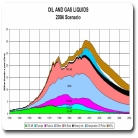
Oil production worldwide peaked/plateaued (whatever works for you) five years ago. Whatever we get from here on in is pretty much guaranteed to cost more; take longer to bring to market; in too many cases be of inferior quality, and will be financially/politically/technologically/practically riskier to obtain. [see this and this, for example]
While I cannot recall now where I read the statistic last month, more than a billion additional cars are expected to grace the planet in the not-too-distant future (mostly in China and India if I recall correctly). That’s just one fossil fuel-consuming product (albeit a big one).
If we no longer have adequate supplies as it is, and cannot rationally (key distinction) expect quality, affordable supply to keep pace with increasing demand—keeping in mind that the “good stuff” is being depleted each and every day and that unconventional supplies are barely keeping pace with those rates of depletion—what happens?
How many component manufacturers in the chain of credit card production are going to find their manufacturing capacities adversely affected when the fossil fuel supplies each and every one them needs is either restricted occasionally or frequently, and/or becomes prohibitively expensive? How many components will be in short supply? For how long? Replacements parts? Transportation capacity?
How many workers up and down the supply chain will have hours cut or eliminated? What’s the ripple effect then?
What if Friendly Bank A finds itself unable to meet your request for a replacement card until … “not really sure when”?
Of course, a collective decision could be reached that credit card manufacturing has been deemed a “Class A, Really, Really Important” Industry and thus will suffer no curtailment whatsoever in fossil fuel supplies up and down the chain.
Of course, that means Some Other Industry will have to sacrifice a bit more….
This is just one industry among how many hundreds/thousands which require full supplies of fossil fuels to get from Point A to Point Z. How long should we continue to deny or keep fingers and toes crossed that Magic Technology is racing to the rescue On Time?
2 Comments on "Peak Oil’s Impact: Credit Cards"
DC on Mon, 23rd Jan 2012 8:26 pm
Interesting article. And this only covers the tip of the tip of the iceberg. Then you consider how those CC are integrated into the economy. How much resources all that expensive credit is designed to serve. The CC companies operations themselves are huge and complex, let alone the economy they are plugged into. People wont know how to live when it start to go away.
BillT on Tue, 24th Jan 2012 1:11 am
Back to paper checks, a monthly statement in the mail every month, and a trip to an actual bank to make deposits and withdrawls? Where is YOUR bank? Within walking distance? Can you balance a checkbook? Will we even have an economy by then? Interesting world coming (back)as oil disappears from our daily lives.