
Peak Oil is You

Donate Bitcoins ;-) or Paypal :-)


Page added on November 27, 2011

Tech Talk – A Second Look at Natural Gas in the Bakken
The comments on the recent post on natural gas flaring at The Oil Drum drew a few comments that I would like to discuss before moving on to start reviewing the situation in Russia.
Most particularly I want to discuss the change in the regulations that are now imposed in the Bakken, and then go on to review the alternate ways in which that stranded gas might be used. I would like to thank those who commented, particularly benamery21, who pointed me to the set of presentations in a Webinar that covers the change. There was also a comment by aws-classifieds that led to a Wood Mackenzie view of the current situation.
The Wood Mackenzie view mirrored to some extent what Sid Green and Rockman have both been noting about the current economics of the shale gas drilling bonanza. Harry Flashman also commented. The point is that much of the growth in drilling for the natural gas in shales such as the Marcellus is coming from Joint Ventures, and
the pool of potential shale gas investors has expanded beyond experienced onshore North American operators to include companies willing to commit up to several billion dollars to enter and develop plays. It can be argued that they have neither the skills nor experience to efficiently exploit the resource and evaluate selling gas into the most liquid, dynamic natural gas market, alien to their own typically regulated natural gas markets.
The continued waves of new investors have committed around US$90 billion to exploiting the shale gas plays in North America, throwing a lifeline to the established players who have been able to continue to hold and exploit their lease holdings using their new investors’ money.
The article goes on to note that the service companies have been making the most out of the current efforts, and as a result companies are beginning to move more of the well servicing in house (including hydraulic fracturing). The article notes, as has been highlighted particularly in comments on earlier posts on the topic, that the majority of shale gas plays are failing to break even at current prices. In consequence it anticipates a market correction, following which only the very best shale gas plays (and that will include those with high liquid content) will survive.
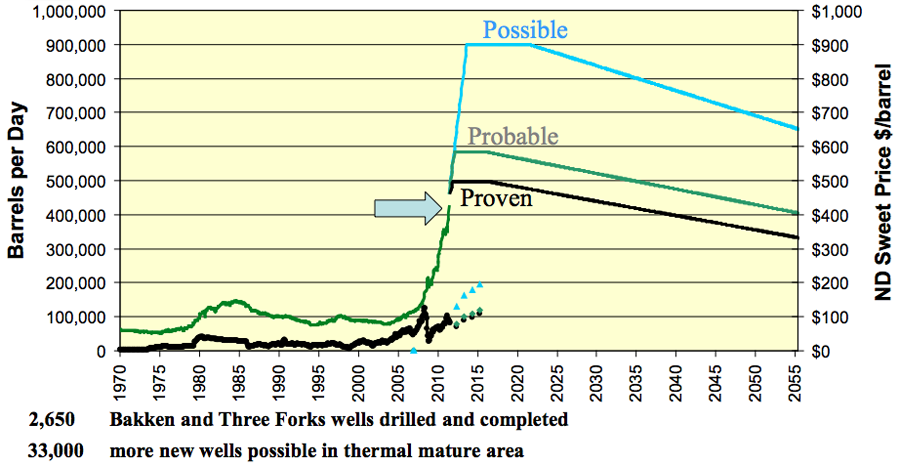
On that note, it is worth looking at the prediction by the North Dakota Department of Mineral Resources at that recent Webinar, which Ben pointed to.
Note that this anticipates that production will only rise by perhaps 150 kbd over current levels. This is perhaps a cautionary tale for those who are looking to see sustained production from these fields of up to 1 mbd through the rest of the decade. DMR sees production declining around 2015, though only at around 1% per year, under a sustained drilling program.
The State, however, notes that 7.6% of the energy value coming from the wells, and 4.3% of the economic value is currently going up in smoke as over 30% of the gas coming from those wells continues to be flared. Regulations do, however, limit the amount of such gas that is flared, through a control on the amount of oil that can be pumped from the well before it is connected into a gas-gathering network.
Typically, wells are allowed to produce at a maximum efficient rate or MER for a period of time (generally 30-60 days) in order to evaluate the potential of the well and stabilize the production. After such time, the well production is then restricted to 200 bopd (barrels of oil per day) for another 30-60 days, then 150 bopd for an additional 30-60 days, and finally 100 bopd until the well is connected to a gas-gathering system. Further extensions may be granted provided certain conditions are met. But whatever the reason, until that connection is made, the only alternative is to burn the gas.
There is a small catch if the well continues to be flared. If the company applies for an exemption, it can be relieved of paying taxes and royalties on the natural gas flared for a year, but after that taxes and royalties can be imposed – even if the gas continues to be flared.
However one “out” is to use the natural gas to produce electric power – provided that the generator consumes at least 75% of the natural gas from the well. At the same time new gas plants are being constructed, so that, by the end of next year capacity should be up to around 1,000 MMcf/day. The use of on-site generators was also mentioned in the Webinar, though all the presentations are sequenced so this appears lower down the site.
Two ways are proposed for effectively using the gas that is currently flared. The first is a modification to the requirement for electrical generators, with a project by Blaise Energy. There is a case study of an existing operation available, where the company installed a 300-kw generator near one well, and a 340-kw generator by another, in North Dakota. The power is then sold to a local electrical co-operative and the company now claims agreements to generate 4 MW, with another 15 MW in view.
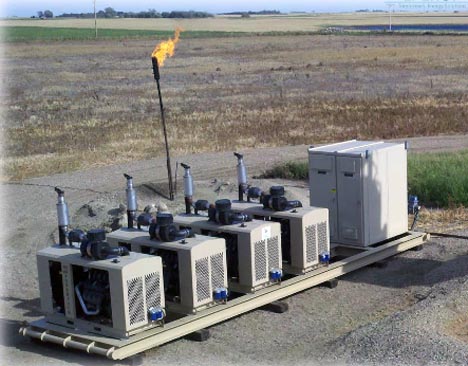

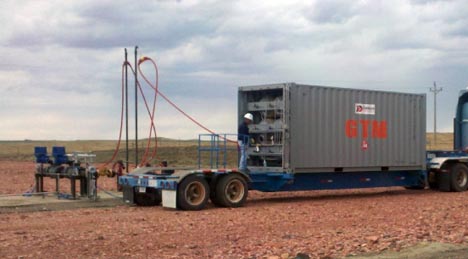
For the present, however, with the growth of CNG-powered vehicles, it is perhaps enough to envisage that before too long the carriers shown above might become a more familiar sight while pulling into the local filling station.
And with that thought, I wish you all a Happy Thanksgiving.
5 Comments on "Tech Talk – A Second Look at Natural Gas in the Bakken"
BillT on Mon, 28th Nov 2011 3:44 am
Interesting concept…but, I doubt that many cars will switch. The costs and the inconvenience is still too great for most. Either way, it will be a slow process with more gas being generated than there is a nearby market for. I see a point where private cars will just be too expensive for the shrinking paychecks of the current drivers and public transit will be more widespread. We shall see.
SOS on Mon, 28th Nov 2011 4:12 am
I sure hope they do switch. I know there are conversions underway in commercial fleets, even though it is being discouragec. The price differenctial is just too great to be ignored.
sunweb on Mon, 28th Nov 2011 9:44 am
No one asks can life on earth including us take more of this abuse.
We will do anything and everything to maintain our present personal level of energy use and the comfort it affords us. We will do anything and everything to the earth, to other people and even to ourselves to continue on this path. And if we don’t have the energy level we see others have, we will do anything and everything to the earth, to other people and even to ourselves to attain that level. The proof of this assertion is simple; we are doing it.
From: The Curmudgeon Report
http://sunweber.blogspot.com/2011/02/curmudgeon-report.html
Kenz300 on Tue, 29th Nov 2011 6:42 am
Several fleet owners were recently recognized for their use of natural gas vehicles.
Waste Management Inc. Deployed their 1,000th natural gas-powered truck and recently committed to purchasing only natural gas-powered units.
Ryder System Inc. They have created the first large-scale, heavy-duty natural gas truck rental and leasing program in the country.
Giant Eagle Inc. Opened its first two CNG fueling stations, available for consumer use and for use by the company’s fleet of delivery trucks.
CNG AND LNG are slowly taking their place in transportation fuels.
BillT on Tue, 29th Nov 2011 2:43 pm
250,000,000 vehicles in the US. At 10 million conversions per year, it will only take until oil is gone to make the switch. ~ 25 years.