
Peak Oil is You

Donate Bitcoins ;-) or Paypal :-)


Page added on November 3, 2011

A Casual Walk Down EROEI Lane
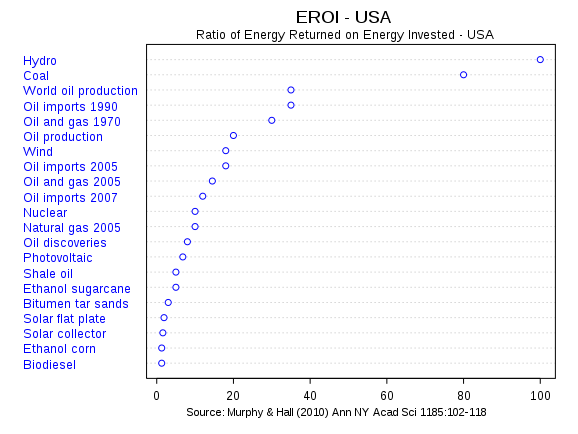
EROEI — or energy return on energy investment — is an interesting concept. A simple equation for calculating EROEI is provided by Wikipedia:
But beware of the false simplicity of equations and charts. The denominator for the equation above: “Energy Expended,” can be devilishly difficult to quantify in simple terms.
EROEI is never quite well-defined because you don’t know how “deeply” you should go in your energy audit. If Joe Sixpack works for a hydroelectric power plant, should you include the energy expenses that his grandfather had to make to get laid with his grandmother? What about the projector in the cinema in 1934 before they had the first intercourse? 🙂 These things were needed for the power plant to work. My example is meant to be amusing but the essence is very serious. _Lubos
When it comes to EROEI, only a range of values is acceptable. If you are given a point estimate of EROEI without error bars or a range — as in the Wiki chart above — you are being lied to.
Robert Rapier is going to delve into the treacherous topic of EROEI in a talk at the ASPO-USA Conference. Robert discusses various ways in which an investment with a low EROEI can be superior to one with a higher EROEI. For example:
… it is possible for a lower EROEI process to be more attractive than a higher EROEI process if the former returns the energy over a shorter time interval. Think of it in terms of interest. Consider an investment that returns 3% on a daily basis versus one that returns 50% on an annual basis. If you invested $1 in each, the 3% daily return will earn you more than $47,000 at the end of one year (assuming you reinvest the returns) while the 50% annual return will earn you 50 cents. But EROEI would simply say that one return is 1.03 to 1 and the other is 1.5 to 1. So, if someone says that a process has an EROEI of 1.5, the first question needs to be “Over what time interval?” _RobertRapier
In fact there are many situations where other factors will trump the narrow EROEI consideration. Environmentalists, for example, may disqualify hydroelectric, coal, nuclear, oil sands, and oil shale, simply on environmental concerns — regardless of EROEI. Utility manager may wish to disqualify wind and solar, based upon their intermittency, expense, requirement for expensive backup facilities, and the fascist way that green governments are forcing such unreliable forms of power production down their throats.
| Energy mechanism | EROEI | Cents/kWh |
| Hydro | 11:1 to 267:1 | 1 |
| Coal | 50:1 | 2 to 4 |
| Oil (Ghawar supergiant field) | 100:1 | |
| Oil (global average) | 19:1 | |
| Natural gas | 10:1 | 4 to 7 |
| Wind | 18:1 | 4.5 to 10 |
| Wave | 15:1 | 12 |
| Solar Photovoltaic | 3.75:1 to 10:1 | 21 to 83 |
| Geothermal | 2:1 to 13:1 | 10 |
| Tidal | ~ 6:1 | 10 |
| Tar sands | 5.2:1 to 5.8:1 | |
| Oil shale | 1.5:1 to 4:1 | |
| Nuclear | 1.1:1 to 15:1 | 2 to 9 |
| Biodiesel | 1.9:1 to 9:1 | |
| Solar thermal | 1.6:1 | 6 to 15 |
| Ethanol | 0.5:1 to 8:1 |
Imagine you are driving through downtown Santa Fe, running low on fuel, and you see two gasoline stations on opposite sides of the street. One sells fuel for $3.85 a gallon, and the other for $10.99 a gallon. The higher priced fuel boasts an EROEI of 10:1, whereas the lower priced fuel can only claim an EROEI of 3:1. Which fuel will you buy, and on what basis?
In fact, we base our energy decisions on price, not EROEI. The fact that prices can change erratically, while EROEI may stay the same, is not a black mark against economics. It is rather a commentary on how simplistic the concept of EROEI is compared to the complexity of life. Pricing in markets reflects far more dimensions of reality than the deceptively simple calculation of EROEI.
Biodiesel- 3:1
Coal- 1:1 to 10:1
Ethanol- 1.2:1
Natural Gas- 1:1 to 10:1
Hydropower- 10:1
Hydrogen- 0.5:1
Nuclear- 4:1
Oil- 1:1 to 100:1
Oil Sands- 2:1
Solar PV (2) – 1:1 to 10:1
Wind (2) – 3:1 to 20:1 _Energy Bulletin
If you can produce and sell power reliably and profitably over a long period of time using a relatively low cost method of production — but the EROEI was only 1.5 to 1 — would you do it? It depends on a lot of things, the EROEI being one of the least important.
EROEI can be important in some contexts, irrelevant in others, and downright misleading in most. I have included three different charts or tables comparing EROEI for various forms of energy production or energy source. Notice that the range of estimates for EROEI is quite wide — where ranges are provided. These ranges are more honest than a simple point estimate, but even such wide ranges can be made obsolete.
As technologies change, EROEIs necessarily change as well. What was once not economically viable suddenly becomes viable, with the introduction of new technologies. 20 year old EROEIs given for deep sea oil, oil sands, oil shales, methane clathrates are less than meaningless today, and will be even less worth considering in 20 years time.
The EROEIs given for wind energy are particularly misleading, given that wind is not dispatchable, has a capacity factor between 20% and 30% at best, and produces most of its power at non-peak demand times. Wind is not present in sufficient quantities for large areas of the globe. Throw away the EROEI for wind, or fool yourself, as you please.
Other forms of energy suffer from the same problem of EROEI irrelevancy. Solar, for example, is also intermittent, non-dispatchable, not suitable for most parts of the world due to issues of weather and latitude. Despite what solar advocates may say, solar energy is not a good match to peak loads most of the year, for most of the planet. Throw away EROEI for solar.
EROEI is a broad and deceptively simplistic measure of energy efficiency, is perhaps best thought of in connection with the broader concept of entropy in a closed system. In open systems, such as those which humans deal in, EROEI has only limited utility, and is most frequently misused and abused when used.
2 Comments on "A Casual Walk Down EROEI Lane"
tubaplayer on Thu, 3rd Nov 2011 10:20 pm
You know, Al Fin, the chart at the top of this discussion has its x axis on the wrong side.
If you plot it the other way round it clearly indicates that it terms of type of energy, for all your pontificating, the more recent the energy form the lower the EROEI. It is getting perilously close to 1:1 the further down the links on the left hand side.
Oh, I agree that developments can lift EROIE considerably. They did at Cantarell – for a while. Once they stop working and you can no longer lift EROEI over that magic 1:1 it really is game over. From where will you get the surplus energy to lift EROEI back over the magic 1:1?
“EROEI is a broad and deceptively simplistic measure of energy efficiency”
Is it? What would you do if you owned a stripper well in some random place and day after day you had to put a barrel of oil into the diesel kit that raised the oil to raise a barrel of oil? I can tell you exactly what you would do. You would shut it down. And that ignores the excess energy that you would have to generate just to maintain the kit.
I have never seen ANYWHERE a complete audit of EROEI for ANY energy source. Ever! Maybe in your obviously superior knowledge to mine you could point me in the right direction.
Look at the chart at the top again Al Fin and reverse it horizontally. Where is it going? It is falling off a cliff in an exponential manner.
BillT on Fri, 4th Nov 2011 9:51 am
This guy is trying to say that 1+1 does not = 2
You have to look at the energy it takes to mine the minerals to make the equipment to mine the minerals. There is no fairy waving a wand and making 20 ton earth movers appear. And solar electric certainly is not going to generate the energy to melt the ores to make that 20 tons of steel, then machine it into the components needed, assemble it, and truck it to the mines. We have not even mentioned the fuel needed to power it for it’s lifetime, which cannot be done with a solar panel and a small battery.
The depth of denial is astounding. It’s as if all of the support equipment and energy is going to magically appear to produce that barrel of oil.
Somewhere recently, I read an article that stated that nuclear is at best a break even for energy. The amount required to build the facility, run it, dismantle it and safely store the spent fuel for maybe hundreds of years, likely EXCEEDS the amount of energy produced over it’s life time.