IEA Acknowledges Peak Oil

If you go to the executive summary of the 2009 International Energy Agency World Energy Outlook, and search for “peak oil”, your browser will come up empty. The whole subject was so beneath the dignity of a serious energy agency that they didn’t even bother mentioning it.
However, yesterday, the 2010 IEA World Energy Outlook became available. And if you repeat the exercise in that executive summary, you will come upon a section titled:
Will peak oil be a guest or the spectre at the feast?
Followed by an explicit discussion of the whole question. The IEA’s position is summarized in the graph above – conventional crude oil production has already peaked in 2006! Suddenly, the subject of impending peak has gone from not worthy of discussion to in the past already!
However, all is not lost: in their projections natural gas liquids and unconventional oil production (tar sands, coal-to-liquids, etc) will cause the total liquid production to continue to gradually increase out to 2035.
However, as
last year, but with much more emphasis this year, they note that slow growth in total supply, combined with rapid growth in developing countries, means that developed countries will be using less oil in future:
All this is in their “New Policies” central scenario. This assumes, roughly, that governments make some real, if halting, efforts towards the commitments they made at the Copenhagen conference.
Alas, if you rely on the New York Times, you’d still be in the dark. The piece on the report doesn’t make a peep about peak oil (being focussed entirely on the China demand growth aspect of the report, which is admittedly interesting and important).
Anyway, the materials on the World Energy Outlook website are well worth reading in full – the IEA definitely seems increasingly reality-based.
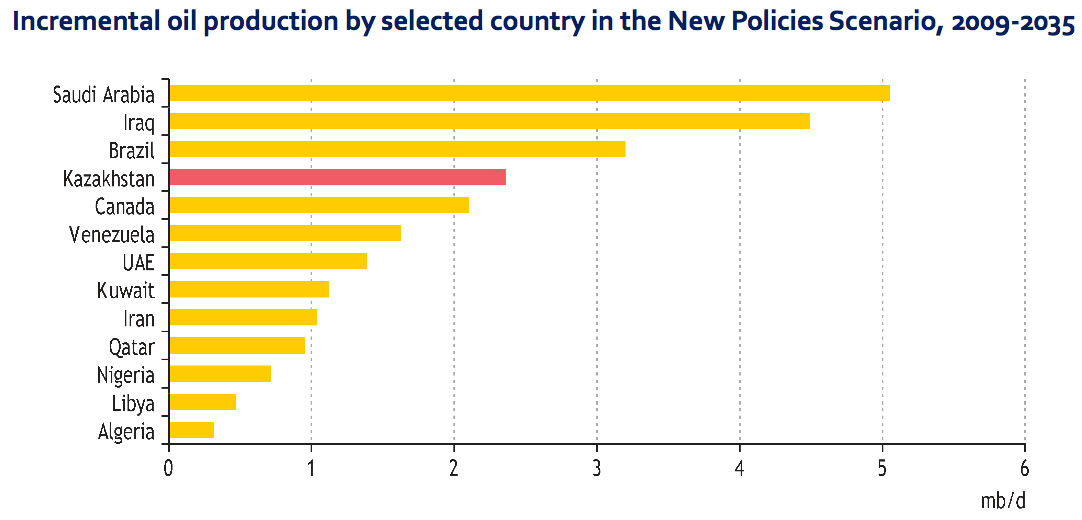
Although there is still this:
I’ll eat my hat if Saudia Arabia is producing 13 million barrels/day in 2035.




KenZ300 on Thu, 11th Nov 2010 6:35 am
Globalization gets expensive when oil is no longer inexpensive.
It is time to look to producing energy locally with local labor.
Clean, sustainable alternative energy needs to be produced locally to provide for economic and national security.
Wheeldog on Thu, 11th Nov 2010 9:25 am
There is a rising tide of acceptance of the concept of peak oil. From the U.S. military to Lloyds of London and an increasing number of governments and communities the awareness of PO has gone mainstream. Unfortunately, little is being done in the U.S. to educate the general public about the implications of stagnant and, eventually, declining net energy supplies. Unconventional oil (tar sands, shale kerogen, etc.) will not fill the void. Life is about to get very interesting.
Simon in BC on Thu, 11th Nov 2010 1:16 pm
I like how the crude oil yet to be found and crude oil yet to be developed nicely fills in the gap produced by the ever diminishing current oil production. And then the stick natural gas liquids and unconventional oil on top of that to give us an ever in increasing amount of fossil fuel. Nothing to see here folks. All we have to do is get that gas mielage up and ride our bikes once a week and eveything can continue as before.
KenZ300 on Fri, 12th Nov 2010 12:56 am
The world economy is built on cheap oil.
In 2008 when oil went to $147 / barrel we got a look at what high oil prices will do to the world economy.
Our economic security and national security will depend on our ability to transition to clean, sustainable alternative energy.
Will we transition fast enough to reduce the impact of higher oil prices?
Timson on Fri, 12th Nov 2010 2:52 pm
As far as the US is concerned, with a majority of people living close to the coast and no developed railroad system, real globalization will get cheaper when it’ll cost $6 a gallon to fill up a truck.
Much cheaper to get your stuff from 5000 miles overseas then 500 miles inland. And that’s on top of cheap labour abroad. An extra challenge for the local economy.